
Contents · 15 sections
- 1. Opening Without a Concept
- 2. Location Mistake
- 3. Not Knowing the Cost Price (Food Cost)
- 4. An Overly Extensive Menu
- 5. Absence of a Brand (Logo Only)
- 6. You Have No Personnel Strategy
- 7. You Weren't Ready for AQTA
- 8. Wrong Pricing Strategy
- 9. Inability to Read a P&L (Profit/Loss)
- 10. Opening Marketing Without a Plan
- 11. Treating Wolt/Bolt/Yango as an Ally
- 12. The Owner Stays in the Kitchen
- Conclusion — Collection of 12 Mistakes
- CHECKLIST — Before Opening
- How Does DK Agency Help?
Hundreds of new restaurants open in Azerbaijan every year. The owner is excited until opening day — the banner is hung, the ribbons are cut, friends have come, a story has been posted on Instagram. 6 months later, however, the same person is watching another restaurant's opening ribbon — this time because his own restaurant has closed.
A significant portion of restaurants opening in Baku and the regions close before completing their first year. The reason? "There were no customers," they say. "There was a crisis," they say. "The location turned out bad," they say.
The truth is different. Restaurants don't close from a lack of customers — they close from strategic mistakes made before opening. Opening day is too late. The mistakes have already been made.
In this article, we present to you the 12 most costly mistakes we have observed in Baku and the regions of Azerbaijan. For each one, a solution, a real example, and where to find help are shown.
1. Opening Without a Concept
A "everything for everyone" restaurant is doomed to be nothing for no one. The owner says: "In my restaurant, everyone will find what they want." This is a marketing disaster.
If you don't know your target customer — family, business lunch customer, young people, tourist — then the menu, design, price, location, even the music level will be wrong. Everything stems from the concept. If there is no concept, every decision is a guess.
Baku reality: A restaurant opened in Yasamal. The owner is 45 years old, wants a "family restaurant," but there is hookah on the menu. The windows are large, but inside there is dim lighting and loud music. A family customer comes in — sees an unsuitable environment for their child. Young people come — the atmosphere is family-oriented, not appealing to them. It closes 4 months later.
Solution: Before opening, write a 1-page concept document. It includes:
- Target customer (describe in 3 sentences — age, income, motivation)
- Price range (average check)
- Atmosphere keywords (5-7 words)
- Menu center line (3 food categories)
- Location profile (which location type is suitable?)
This document is the constitution of your business. Return to it in every decision.
2. Location Mistake
In the restaurant business, the most expensive and most irreversible decision is location. Wrong location = 6-12 months of loss + relocation costs + brand damage.
4 questions before choosing a location:
-
How many meters is the frontage? For a döner restaurant, minimum 4m (window display matters), for a café 6m+, for fine dining 5m+. An entrepreneur who opens a döner shop with 3m of frontage says "customers don't see it" — they do see it, but they can't look inside.
-
How many people pass by on foot daily? Between 9:00-22:00. Count it yourself: count the people passing in front of your chosen spot on different days and at different hours.
-
Within a 500m radius, which competitor is in which price range? If there are 3+ competitors with the same concept, you end up in a price war. If there are none, you've either found a gold mine or there's no market demand.
-
Is there parking? Is it at a junction point in a mall? An entrepreneur who doesn't factor in Baku's parking problem loses a portion of customers — they circle the streets and go to another restaurant.
Baku reality: An entrepreneur who opens a business lunch restaurant next to the 28 May metro station breaks even in 4 months. The same concept opened in Bayıl is still at a loss after 8 months. Location = traffic = revenue.
3. Not Knowing the Cost Price (Food Cost)
This is the quietest killer that drives a restaurant to its death. In Azerbaijan, many restaurants don't know the true cost price of each portion.
The owner says: "I sell chicken sac for 18 manat. The profit is great." The math shows:
- Meat cost: 2 AZN
- Vegetables: 0.5 AZN
- Oil + spices: 0.3 AZN
- "Total 2.8 AZN. 18-2.8 = 15.2 AZN profit. Fantastic!"
Wrong. What isn't calculated:
- Trim loss (bones come out of the chicken, 15% loss = 0.3 AZN extra)
- Operational loss (burned, returned, waste = 3% = 0.08 AZN)
- Napkin, skewer, packaging (for delivery) = 0.5 AZN
- Dish and cutlery depreciation, breakage = 0.15 AZN
Real food cost: 3.83 AZN. What's left of 18 AZN is 14.17 AZN. From this, staff, rent, utilities, and taxes still have to be deducted — the money left per portion is far less than you think. This is theoretical profit; in reality it is often negative.
Solution: See our guide on how to calculate food cost. Gram-by-gram recipe, including trim loss, with operational loss layered in.
4. An Overly Extensive Menu
A novice entrepreneur puts together a menu of 80-100 items. The logic: "the customer wants lots of choices." The result is a disaster:
- Inventory bloats — 100 dishes = hundreds of ingredients = a large inventory
- Waste increases — the ingredients for a slow-selling dish spoil
- Kitchen time stretches out — the chef can't keep up with 100 recipes, quality drops
- The customer becomes indecisive — the Cheesecake Factory effect, decision fatigue
In reality, the customer orders the same 15 dishes. The remaining 65 items only create cost and confusion.
Solution: Start the opening menu with 25-35 items. After 3 months, look at the POS data: cut the bottom 20% of dishes (Menu Engineering logic). Deepen the rest — better recipe, higher margin. See the Menu Engineering article.
Baku reality: Two new restaurants opened on Nizami street. One with a 95-item menu, the second with a 28-item menu. After 6 months: the 95-item one closed, the 28-item one expanded. A small menu = focus = quality = loyalty.
5. Absence of a Brand (Logo Only)
"I made a logo, in red, under the restaurant name. It's beautiful." This is not a brand — it's only a stamp.
A brand is what the customer feels about your restaurant. This sounds very abstract, but at the operational level it is extremely concrete:
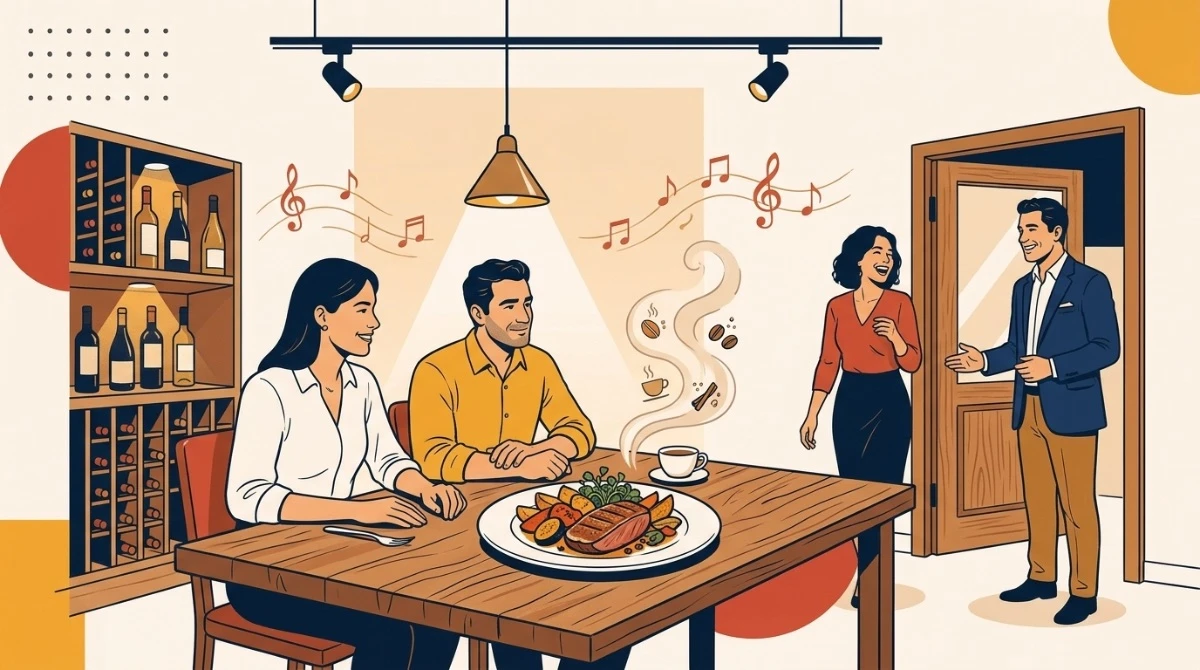
- Greeting — what happens at the door? A greeting? An empty stare?
- Smell — what do you feel when you walk in? Food? Cleanliness? Staleness?
- Music — level, genre, changes from time to time
- Light — daytime, evening, romantic, business
- Dishware — ceramic? Glass? Cheap porcelain?
- Staff language — how do they speak? Respectfully? Rudely?
- Delivery rhythm — what arrives at the table and when?
All of these are the brand. The logo is only the stamp placed on these feelings. The logo is a finishing step, not a starting one.
Solution: Answer 5 questions before opening:
- Describe my restaurant in 3 words
- What should the customer feel when leaving?
- Without which music is it not my restaurant?
- Which 1 detail none of my competitors have?
- How would a customer tell a friend about my restaurant?
These 5 answers are the brand. The logo comes after that.
6. You Have No Personnel Strategy
"I found a chef, I found a waiter, I started." This is not personnel recruitment — it's panicked rushing.
Questions with no answers:
- Which positions are critical? (head chef + owner + guest manager)
- Which ones are replaceable? (assistants)
- Which ones can be outsourced? (cleaning, accounting)
- Is there a job description for each one?
- Is there a training system? Or do you say "they'll learn on the job"?
- A plan for resignation cases? (In Baku, waiters change frequently)
Solution: Prepare an org chart before opening. Minimum for a 60-seat restaurant:
- Head chef + 2 kitchen assistants (1 hot kitchen, 1 cold kitchen)
- 4 waiters (2 shifts)
- 1 guest manager / cashier
- 1 bar manager (if there's a drinks menu)
- 1 cleaner / dishwasher
- 1 manager (yourself or hired)
For each position, a written document: job description, daily checklist, salary range, evaluation criteria. See the employee retention article — 7 retention systems.
7. You Weren't Ready for AQTA
An AQTA (Azerbaijan Food Safety Agency) inspector comes without warning. They come at the wrong moments — during peak hours, during opening week, or after a customer complaint.
If you're not ready:
- No refrigerator temperature log → risk of fine
- No HACCP plan on paper → 300 AZN
- Staff health certificates expired → 100-150 AZN per person
- Spider webs, rodent traces in the kitchen → heavy fine and risk of suspension of operations
- No warehouse temperature log → 200-400 AZN
- No toilet paper, soap (during inspection) → 100 AZN
Along with fines, suspension of operations is also possible. It is practically impossible for a newly opened restaurant to withstand such a blow.
Solution: Before opening, complete DK Agency's AQTA inspection preparation list. Included: HACCP plan, temperature log template (filled in daily), staff health certificates (for each staff member), cleaning plan on paper + in practice (who, when, cleans what). See our AQTA inspection preparation article.
Important: You can apply to AQTA yourself — before paying an intermediary, learn the official procedure from ASAN service.
8. Wrong Pricing Strategy
"My competitor sells for 15 manat, so I'll sell for 14 manat. I'll win customers with a small discount." This is not competition — it's suicide.
The reason is simple: your competitor's food cost, rent expense, and staffing level differ from yours. Their 15 AZN may be healthy profit, while your 14 AZN is at a loss.
Baku reality:
- The same Yasamal kebab shop, different owners
- One sells kebab at 14 AZN — the owner says "It's fine, we're busy"
- Another at 16 AZN — "It's fine, quiet but profitable"
- A third at 12 AZN — closed within 3 months
Solution: Price comes from food cost and target profit, not from the competitor:
Selling Price = Food Cost ÷ Target Food Cost %
Example: 6 AZN food cost ÷ 30% target = 20 AZN minimum selling price. Even if a competitor sells at 17 AZN, you should not set your price below 20 manat — otherwise you're at a hidden loss on every portion.
Exception: An opening campaign may offer a 15-20% discount during the first 30 days (as an acquisition marketing expense). Then return to the normal price.
9. Inability to Read a P&L (Profit/Loss)
The owner looks at the cash register every evening: "We took in 3000 AZN today, good day." At the end of the month, the accountant brings the report — 4000 AZN loss. How?
The answer is simple: the cash register is not a report. The P&L is. Even if you earn 3000 AZN every day, if you spend 3200 AZN every day, you end up with roughly a 6000 AZN loss at month's end.
The 5 lines of a P&L:
- Net Revenue — sales after tax (100%)
- COGS (Food) — 28-32% target
- Labor Cost — 25-30% target
- Fixed Cost — 15-20% target
- EBITDA (True Profit) — 15-25% target
Track each one as a separate trend. Place 3 months of P&L side by side — the problem reveals itself within 1 month and is solved within 2 months.
Solution: See our P&L Report article. Set aside 1 hour a month — 12 hours a year = an eye opened to your financial reality.
10. Opening Marketing Without a Plan
"We opened, customers will come." This is not a plan — it's hope. Hope is not a strategy.
The first 30 days are the opening window. In Baku, there's a flow of "trial customers" in front of a newly opened restaurant — people come for the novelty. If you don't manage this window with a plan, very few customers become loyal, and the rest come once and leave.
Opening marketing in 3 phases:
T-30 days (1 month before opening):
- Create local Instagram + Facebook accounts
- 4-5 preparation posts (behind-the-scenes, kitchen preparation, chef introduction)
- Local hashtags (#bakirestoranlari #yasamalrestoran)
- Set up a Google My Business profile, add photos
T-14 days (2 weeks before opening):
- Invite micro-influencers (5K-20K followers, local AZ food bloggers)
- Pre-opening tasting — 3-4 people, show each of them 3 dishes, have them take photos
- Press release — to local food blogs, platforms like Lokal.az, Trip.az
- Pre-announcement in local Telegram groups
T-0 (opening week):
- Opening campaign — "30% discount for the first 50 customers" or "set menu for 25 AZN"
- Run it for 30 days, then switch to a loyalty program
- Collect every customer's phone number / Instagram — for retargeting
- Yandex.Direct + Facebook Ads — 200-500 AZN/week test budget
11. Treating Wolt/Bolt/Yango as an Ally
Delivery platforms are not your partner — they are an intermediary tax collector. From a 30-manat order:
- The platform commission takes a significant portion of the order — get the exact percentage from your own contract
After food + packaging + time spent preparing for the driver, you're left with 2 manat, or you're at a loss.
Baku reality: A Yasamal cafe owner left Wolt after 2 months. "It looked like 4000 AZN in delivery revenue per month, but in reality only 800 AZN remained. Commission + packaging + extra staff = there was nothing left."
Solution: Three options:
- Price the delivery menu separately — 15-20% higher than the in-house menu. Add a note to the customer under the menu: "Prices on platform orders include commission."
- Set up in-house delivery — courier, phone order line, Telegram bot. The first months may be at a loss — plan the budget in advance.
- Choose only 1 platform — the one with the lowest commission, focus on it, build loyalty. Being strong on 1 is better than being on 3.
Check out our Wolt/Bolt/Yango Commission Math post — a detailed calculation.
12. The Owner Stays in the Kitchen
"I'm a chef myself, I'll prepare all the dishes myself at opening." This strategy lasts 3 months. In the 4th month, you:
- Get physically exhausted (standing in the kitchen for 12 hours)
- Can't leave the kitchen (who else will know how?)
- Can't look at finances (no time)
- Can't do marketing (no time + no energy)
- Can't look at the business
A restaurant lives more on the owner's energy than on sales. When the owner's energy runs out, the restaurant runs out too.
Solution: Hire a chef from day one. You are an owner-proprietor, you must manage the business, not the food. An owner who stands in the kitchen 12 hours a day burns out in 6 months. A chef is an additional expense — but your attention stays on the business, and this expense pays for itself.
The owner's day should look like this:
- Morning (2 hours): P&L, orders, inventory check
- Peak hours (3 hours): in the dining room — talk to customers, solve problems, manage staff
- After evening (2 hours): marketing, evaluation, strategy
Standing in the kitchen — is being an operations worker, not an owner.
Conclusion — Collection of 12 Mistakes
These are not just a list — they are a deadly graph that leads the restaurant to death. If you make one, you might get away with it. If you make 2-3, you're done for.
| # | Mistake | Risk level |
|---|---|---|
| 1 | Opening without a concept | 🔴 Critical |
| 2 | Wrong location | 🔴 Critical (irreversible) |
| 3 | Not knowing food cost | 🔴 Critical |
| 4 | Too extensive a menu | 🟡 Medium |
| 5 | Only a logo, no brand | 🟡 Medium |
| 6 | No staff strategy | 🟡 Medium |
| 7 | No AQTA preparation | 🔴 Critical (fine + closure) |
| 8 | Wrong pricing strategy | 🔴 Critical |
| 9 | Can't read P&L | 🔴 Critical |
| 10 | Opening marketing unplanned | 🟡 Medium |
| 11 | Not counting delivery commission | 🟡 Medium |
| 12 | The owner stays in the kitchen | 🔴 Critical (long-term) |
There are 7 critical mistakes. Each one shortens the restaurant's life; when several come together, the risk grows much larger. If you make three — it's a blessing if you even make it to opening day.
CHECKLIST — Before Opening
| # | Step | Status |
|---|---|---|
| 1 | Write a 1-page concept document | ☐ |
| 2 | Answer 4 questions for location + analyze 3 competitors | ☐ |
| 3 | Calculate the food cost of all dishes gram by gram | ☐ |
| 4 | Reduce the menu to 25-35 items | ☐ |
| 5 | Answer the 5 brand questions, then the logo | ☐ |
| 6 | Org chart + job description for each position | ☐ |
| 7 | Complete the AQTA 47-item checklist | ☐ |
| 8 | Calculate pricing strategy with a formula | ☐ |
| 9 | Learn the P&L template, fill in a 1-month sample | ☐ |
| 10 | Prepare a 30-14-0 marketing plan | ☐ |
| 11 | Separate pricing for the delivery menu, choose 1 platform | ☐ |
| 12 | Hire a chef — get out of the kitchen | ☐ |
Opening after 12/12 is complete — otherwise waiting will be more expensive.
How Does DK Agency Help?
DK Agency's free tools help you spot these mistakes before opening:
- 🎯 Location Analysis — evaluates the location against criteria, shows risk signals and break-even sales
- 🍳 Food cost — ingredient-by-ingredient portion cost including trim loss, and selling price based on target percentage
- 📊 Profit and loss statement (P&L) — shows net profit from the month's sales and expenses
- 📋 Preparation for AQTA inspection — section-by-section check on hygiene, documents, food storage
- 🎨 Branding guide — brand name, brand slogan, guest, colors and a 12-step checklist
The most expensive mistake at opening is repeating someone else's mistake. If you open knowing the 12 mistakes in this article — you have already avoided more than half of them.
Enlightened hospitality: employees first, then guests, community, suppliers and investors.
If there is one thing that instills humility in a person forever, it is the restaurant business.
How DK Agency helps
If what this post describes is happening in your restaurant, café or hotel, write to us: we will look at it together and show you the first step. The first diagnostic is free.
Ask KAZAN AI about this topic
Your dish, your numbers. KAZAN AI answers from the DK knowledge base and points you to the right tool.
Open KAZAN AI