
Series: Does the venue make money? — 3/3
You walk into a restaurant. The food is delicious, the price is normal. But you cannot sit for more than 40 minutes: your eyes get tired, your head aches, there is an unexplained rush inside you. You ask for the bill and leave.
You walk into another place to drink tea — half an hour passes, and you do not notice. You order another coffee and another dessert.
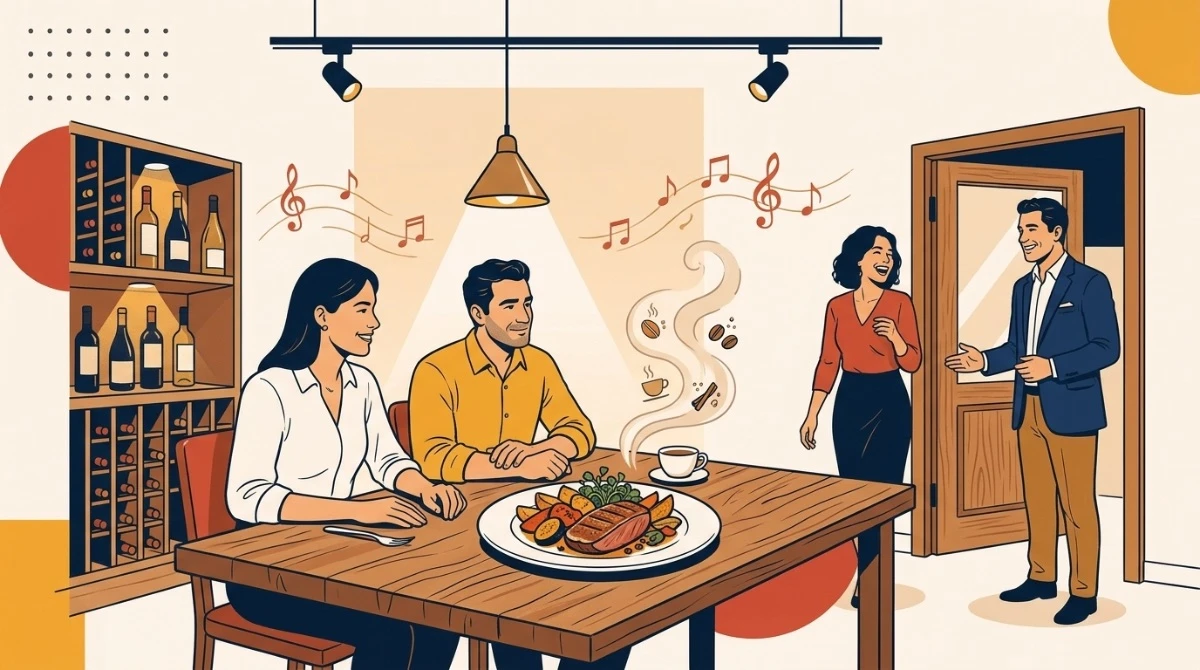
The difference is not in the chef. The difference is in the light, the smell, the sound, and the final impression. The guest 'eats' these before the meal.
In the 1st article we discussed the 7 pillars of the venue, in the 2nd article the flow. In this article, we open the remaining three pillars — light, feeling, and departure.
1. The three layers of light
In an inexperienced project, twenty cold white lamps are placed at equal intervals on the ceiling, and the work is considered finished. This is not a restaurant — it is an operating room.
[1. GENERAL LIGHT]  ──► the soft background of the hall, does not hit the eye directly
[2. TABLE LIGHT]  ──► warm, narrow light falling on the center of the plate
[3. ACCENT LIGHT] ──► a spot showing the wine cabinet, the bar, the stone wall
- General light: soft background coming from hidden cornices and wall sconces. It decreases in the evening — a dimmer is important.
- Table light: on every table, warm light that falls not on the guest's eyes, but on the center of the plate. The lamp's color rendering index (CRI) should be above 90 — meat, tomato, and greens should appear in their own color. A cheap lamp makes steak look gray.
- Accent light: the wine collection, the dessert in the display case, the stone wall. The eye goes to the brightest point — you choose that spot.
For the guest hall, warm light (2700–3000K). The kitchen is different: there, neutral, strong work light is needed so the chef can see the color of the food correctly.
For being noticed from afar, facade and sign lighting — in the 1st article.
2. Signature scent
The first scent that reaches the nose of a guest entering through the door colors the entire experience.
Prohibited: floor-washing chlorine, toilet cleaner, old frying oil, heavy chemical room fragrance.
Choose one natural direction matching your concept:
- cafe, confectionery: freshly ground coffee, chocolate, vanilla;
- bread, pizza: freshly baked dough;
- premium restaurant: charcoal, fresh herbs.
How:
- Place the coffee grinder, oven, and display case close to the entrance and hall so the scent spreads naturally.
- Set up ventilation so that air from the restroom and dishwashing area does not return to the hall.
- Do not direct the kitchen exhaust for scent to the street or in front of the door — it creates problems with neighbor, sanitary, and fire regulations. Resolve this with the project designer.
3. Music: tempo by daypart
Music is not sound that fills emptiness, it is the rhythm of the venue.
There is real research: Ronald Milliman in 1986 compared slow and fast background music in a restaurant. With slow music, guests stayed at the table longer and the bar bill increased; the food cost, however, remained almost unchanged (Journal of Consumer Research, 1986).
The practical rule that follows from this:
- Lunch: rhythmic, energetic music — the guest is not rushed, but the table turnover does not drag.
- Afternoon dead hours: quiet background music.
- Evening: slow jazz, acoustic, quiet — the guest relaxes and orders a second drink and dessert.
- Volume level: the guest should be able to talk to the person across from them without shouting.
- Do not leave the music to the employee's taste. There should be a ready playlist for each part of the day. We covered the parts of the day themselves in this article.
4. Touch: the weight of the dishware
Research by Charles Spence and colleagues from the University of Oxford shows that food served with heavy dishware and heavy cutlery can be perceived as higher quality.
- Do not serve an expensive steak with a light, bending fork.
- Serve coffee not in a thin disposable cup, but in a thick-walled cup that keeps it hot.
- The menu paper, the table surface, the chair seat — all tell the guest something about the price.
5. The departure moment: peak-end rule
Nobel laureate psychologist Daniel Kahneman and colleagues have shown that a person remembers and evaluates an experience not as a whole, but mainly by two moments: the most intense moment and the final moment (peak-end rule).
No matter how excellent the food is, in the end:
- if the bill does not arrive within 15 minutes,
- if there is a queue and crowding at the checkout,
- if no one at the exit says "thank you, we look forward to seeing you again",
- if there is a wait for a coat at the cloakroom —
the restaurant remains in the guest's memory as a "tiring place."
A good departure:
- Fast payment: the bill should be settled within 2–3 minutes after it is requested; card payment at the table should be available.
- A final warm touch: a smile and thank you at the door; a small chocolate, a small gift for a child.
- Soft exit lighting: there should be no sudden bright white light at the door — the guest should transition gently from the atmosphere of the hall to the street.
- Final brand message: something should remain in the mind of every departing guest — a sentence, a taste, a gesture.
CHECKLIST — The Feel of the Venue
| # | Area | Check | Status |
|---|---|---|---|
| 1 | Light color | Warm light in the guest hall (2700–3000K); separate task lighting in the kitchen | ☐ |
| 2 | Table lighting | The light falls on the plate, not in the guest's eyes | ☐ |
| 3 | Dimmer | General lighting is reduced in the evening | ☐ |
| 4 | Scent | A signature scent is noticeable at the entrance, not a chemical one | ☐ |
| 5 | Ventilation | Toilet and dishwasher air does not return to the hall | ☐ |
| 6 | Music | There is a separate playlist for each part of the day | ☐ |
| 7 | Payment | The bill is settled within 2–3 minutes after it is requested | ☐ |
| 8 | Last impression | Every guest leaving is thanked | ☐ |
📝 DOGAN'S NOTE: "If a guest turns and looks at the restaurant once more while leaving, congratulations — you didn't just fill their stomach, you left a mark. That guest will return. If they run out the door, it means you are not managing the venue, the venue is managing you."
💡 DK Agency: For the brand's feel and language standards, see the Branding Guide. The quality badge of guest experience — SEDD Rozeti.
🌐 dkagency.com.tr | 📍 Baku, Azerbaijan
Have a question about this?
If this situation sounds like your restaurant, write to us. The DK Agency team will reply.