
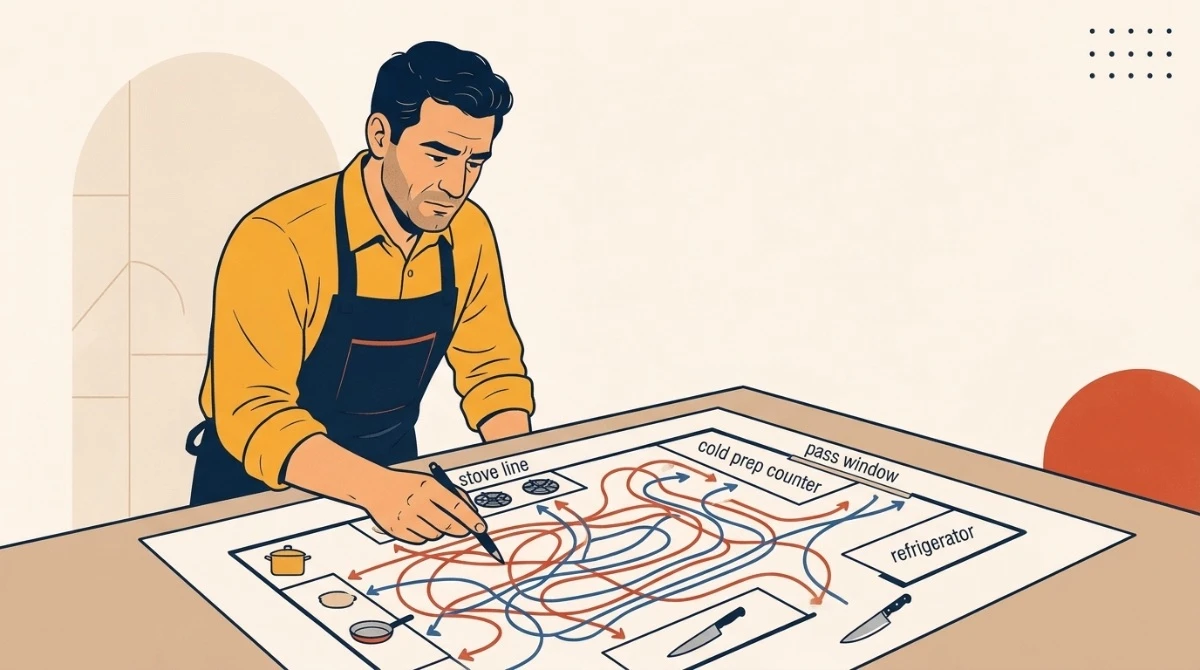
It's peak hour. You look at the kitchen: everyone is drenched in sweat, everyone is running. Out in the dining room, the waiters are rushing back and forth. But the orders are still late.
The first thing that comes to mind: "There aren't enough people. I need to hire one more person."
Stop. Don't rush.
Most of the time, the problem isn't a shortage of staff. The problem is that your employee isn't cooking — they're walking. The salad chef goes to the fridge at the other end of the kitchen for every sauce. The waiter crosses the entire dining room for every plate. And at the end of the month, you're paying wages for those steps.
There's a simplest, cheapest way to see this: a spaghetti diagram (a step map). One sheet of paper, one pencil, half an hour.
What is a spaghetti diagram?
You draw the layout of the venue on paper. You pick one employee. Wherever they go, you draw a line with a pencil. Half an hour later, when you look at the sheet, the lines are tangled together and look like spaghetti on a plate. That's where the name comes from.
Wherever the lines get thicker, that's where the bottleneck and the money loss are. Wherever the lines cross, that's where the risk of collision and accident is.
How is it drawn in 5 steps?
- Draw the layout. A simple sketch close to scale is enough. Mark: fridges, storage, prep table, stove/grill, pass-through window (pass), dishwashing area, service station (spoons, napkins, water), till, tables.
- Choose whom to follow. Draw two separate maps — they show different problems:
- Kitchen map: one chef (e.g. salad or grill) — between prep, fridge, spices and bins.
- Service map: one waiter — between tables, till, pass-through window, dishwasher and service station.
- Observe for 30 minutes during peak hour. Connect every movement with a line. As the same route repeats, draw over it again — let the line get thicker.
- Count and measure. Between which two points are the 3 thickest lines? How many times was it walked? How many metres is the distance between them? How many seconds does each trip take?
- Change one thing, then draw it again. Move the equipment, the spice rack, the bin, the service station closer. A week later, observe the same employee for 30 minutes again and put the two sheets side by side.
Example calculation: salad chef and the distant refrigerator
This is a mathematical example — plug in your own kitchen's numbers.
- Between the salad station and the shared refrigerator: 9 meters
- On every salad order, the chef goes to the refrigerator and back once: 18 meters
- 120 salad orders per day
- 120 × 18 m = 2 160 m — more than 2 km a day just to get sauce
- If every trip takes 45 seconds including opening the door and searching: 120 × 45 s = 90 minutes — an hour and a half every day
Solution: a refrigerated prep table is placed under the salad station. Sauces, chopped vegetables, and cheese are kept within reach in lidded gastronorm containers. The chef does not move from their spot — they just reach out.
90 minutes a day come back. That time means either more orders, a calmer shift, or fewer overtime hours.
Front of house: the server's route
Look at two things on the server's map:
1. Empty trips. If the server goes to the table empty-handed and comes back empty-handed, half the trip is wasted. The old rule "go full, come back full" is true, but it is not enough. Three questions on every trip out:
- What am I carrying now?
- What do I check on the way? (empty glass, waiting guest, table to be cleared)
- What am I bringing back?
2. The triangle. The pass, the dishwashing drop-off, and the service station should be close to each other. If the pass is in one corner of the dining room and the dishwashing is in the other, the server crosses the entire dining room after every table. We cover this topic along with dining room dimensions in the Guest and Staff Flow article.
5 seconds at the pass. The server is not just a carrier of plates, but the final check before the guest is reached. Before picking it up: correct table? is the food as hot/cold as it should be? is the presentation as in the menu? are the sauce and side in place? is the plate edge clean?
Safety: intersecting lines
The spaghetti diagram protects not only time but also health. The most serious incidents in the kitchen — hot oil, boiling pot, knife — often happen when two people's paths cross.
- The general walkway must not pass behind the hot cooking line.
- The server must not enter inside the kitchen. Their boundary is the pass.
- The path by which dirty dishes come in and the path by which clean food goes out must be separate.
What is usually changed?
| What appears on the map | Typical solution |
|---|---|
| Chef frequently goes to a distant refrigerator | Under-counter refrigerator at the station, daily prep within reach |
| Bending and searching for spices and utensils | Shelving at eye and hand level, hanging rack |
| Trash bin for scraping plates is far away | Put the bin at the dishwashing drop-off |
| Server goes to the kitchen for spoons and napkins | Service station in the dining room |
| Server and chef paths cross at the door | Separate entry/exit directions, change door position |
The Money Math — With Your Own Numbers
Excess travel minute × number of workers × hourly wage ÷ 60 × work days = money paid for wasted travel per month
Example: 3 workers, each 40 minutes of extra travel per day, hourly wage 6₼, 26 days per month: 40 × 3 × 6 ÷ 60 × 26 = 312₼/month. This is only salary — delayed orders, cooling food, and quitting due to fatigue are not included.
CHECKLIST — Tomorrow in the Kitchen
| # | Check | Status |
|---|---|---|
| 1 | Is there a refrigerator within reach at the salad/cold station? | ☐ |
| 2 | Are spices and sauces one step away? | ☐ |
| 3 | Does the grill cook move from his spot for tongs and dishes? | ☐ |
| 4 | Does the waiter stand at the service window, or enter the kitchen? | ☐ |
| 5 | Do the dirty dish route and the clean food route intersect? | ☐ |
| 6 | Is the trash can more than 3 steps away for scraping plates? | ☐ |
| 7 | Has at least one worker's 30-minute map been drawn this week? | ☐ |
📝 DOGAN'S NOTE: "When you look from the kitchen door, if everyone is shouting at each other and running here and there with a pan in hand, there is no laziness there — there is a wrong plan. The kitchen should be like clockwork: everyone turns in place, no one runs from their spot."
💡 DK Agency: To calculate the number of stations and shift load, use the Kitchen Station Calculator and Staff Planner. If you are opening a new venue — From Construction to Opening Checklist.
🌐 dkagency.com.tr | 📍 Baku, Azerbaijan
DK AGENCY NOTE
Have a question about this?
If this situation sounds like your restaurant, write to us. The DK Agency team will reply.