
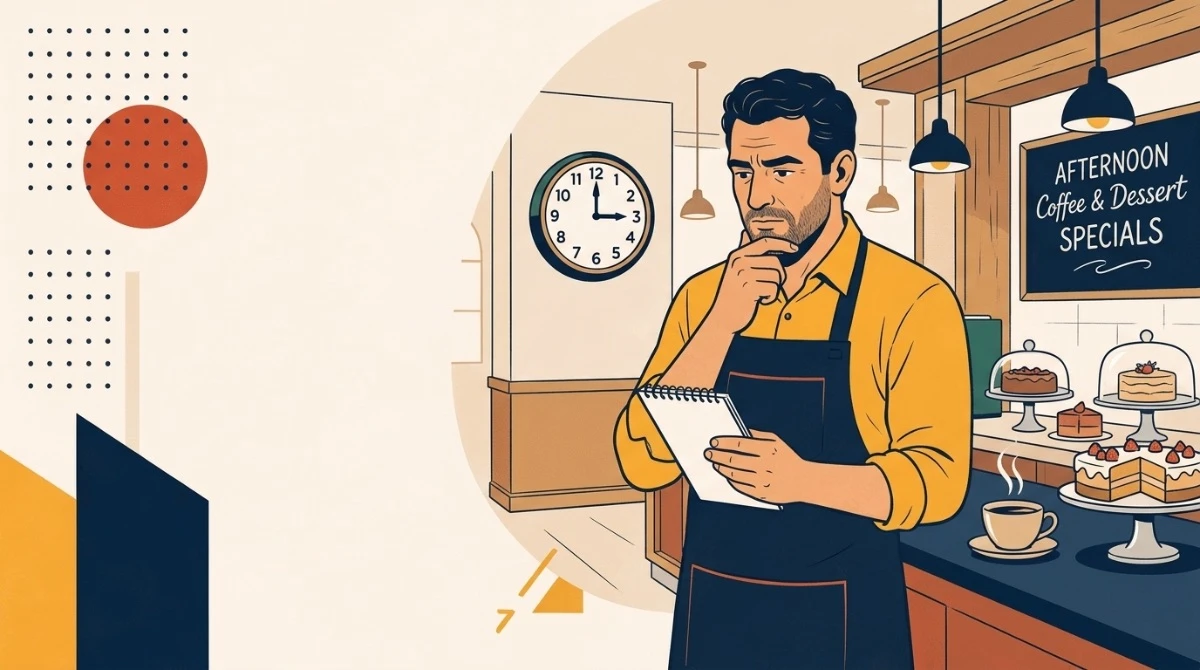
It's 15:30. Of the 20 tables in the hall, 2 are occupied. The waiters are looking at their phones in the corner, the lights are on, the AC is running, the rent clock is ticking.
The owner says: "Lunch gets by, dinner gets by. In between, the restaurant sits empty."
The reason isn't the guests. The reason is that you treat the restaurant as a single business. Morning, lunch, afternoon and evening — the same menu, the same display, the same music.
Yet the guest rushing in the morning and the guest sitting with friends in the evening are not the same person. A successful restaurant operates as 5 different businesses over the course of a day. In the world, this is called day part; here we call it day-part management.
One day — five different guests
The hours are typical. Take your own hours from the cash register (POS) report.
1. Morning (06:30–10:30): the guest in a hurry
- What they want: speed, freshness, energy. They have no time to sit down.
- What to offer: fresh coffee, a warm croissant, a sandwich, packaging ready to take away.
- Goal: a fast check, no queue forming.
2. Lunch (11:30–14:30): the time-poor guest
- What they want: a filling meal, a reasonable price, fast service. Their break is 45–60 minutes.
- What to offer: the lunch set of the day (soup + main course + drink), the dishes that come out fastest pushed to the front of the menu.
- Goal: table turnover — the guest eats their fill, leaves on time without being rushed, and the next one takes their place.
3. Afternoon — the dead hours (14:30–17:00): the hour of opportunity
- Who they are: freelancers, students, informal meetings, people tired from shopping.
- What they want: comfort, quiet, something sweet.
- What to offer: not a main course — a "coffee + dessert" set, a tea set, waffles, crêpes, a light snack.
- Goal: to cover the idle staff and the rent clock with high-margin sales.
4. Evening (18:00–21:30): the main profit
- Who they are: families, couples, friends. They are not in a hurry; they want to stay 1.5–2 hours.
- What they want: attentive service, flavour, presentation.
- What to offer: signature dishes, grilled items, shared appetiser plates, drinks and dessert.
- Goal: to grow the average check. Rushing is harmful here — offer the second drink, the dessert. We discussed how to offer it in The Waiter Doesn't Take Orders, He Sells.
5. Night (after 22:00): young people and late workers
- What to offer: quickly prepared, hand-held snacks, saucy wings, burgers, hot sandwiches.
- Target: high-margin snacks and drinks. Heavy pot dishes are not the product of this hour.
Summary table
| Hour | Guest | Menu highlight | Display center | Atmosphere | Target |
|---|---|---|---|---|---|
| 06:30–10:30 | In a hurry | Coffee, croissant, sandwich | Fresh buns, coffee cups | Lively, bright | Fast check |
| 11:30–14:30 | Short on time | Lunch set, soup of the day | Set of the day, salads | Fast-paced | Table turnover |
| 14:30–17:00 | Relaxing | Coffee + dessert | Bright desserts | Calm | Revive the dead hour |
| 18:00–21:30 | Hosting a gathering | Signature dish, grill, drinks | Premium dessert | Slow, warm light | Average check |
| 22:00+ | Enjoying | Snacks, burger | Snacks | Lively | High-margin snacks |
We cover changing the display by hour in Display Hot Spots, and music and lighting in 3-Layer Light, Scent and the Moment of Separation.
Days of the week differ too
Monday's lunch guest and Thursday's evening guest are not the same. Weekend breakfast can be a separate business. Build the schedule not only by hour, but also by day: which day which segment is strong, and which is weak?
Where to start? A 4-week plan
- Week 1: pull the hourly sales report from the POS system. Find the 2 weakest hours.
- Week 2: prepare one offer for those hours (e.g. "half-price dessert with any coffee"). Put it on the menu, the display, the entrance. Teach the waiters what to say.
- Week 3: every day, record the check count and average check for those hours.
- Week 4: compare. If it works, keep it; if not, change the offer — not the hour.
Example calculation (put in your own numbers): 15 extra checks per day between 14:30–17:00 × 7₼ × 26 days = 2,730₼ additional turnover/month. Check the margin with the Menu Matrix — offer a product that is not cheap, but profitable.
CHECKLIST
| # | Step | Status |
|---|---|---|
| 1 | Hourly sales report pulled, the 2 weakest hours identified | ☐ |
| 2 | An offer for 14:30–17:00 is ready | ☐ |
| 3 | The fastest-to-serve dishes on the lunch menu were highlighted | ☐ |
| 4 | There is a separate music playlist for morning and evening | ☐ |
| 5 | Waiters were briefed separately for lunch speed and the evening offer | ☐ |
| 6 | The display-change schedule by hour was written out | ☐ |
📝 DOĞAN'S NOTE: "Kebab is for the evening. But who will pay for the three o'clock hour? A restaurant must breathe by the hour — one way in the morning, another at noon, another in the evening."
💡 DK Agency: Check your hourly revenue-expense balance with the P&L Simulator, and which product truly earns with the Menu Matrix.
🌐 dkagency.com.tr | 📍 Baku, Azerbaijan
Have a question about this?
If this situation sounds like your restaurant, write to us. The DK Agency team will reply.