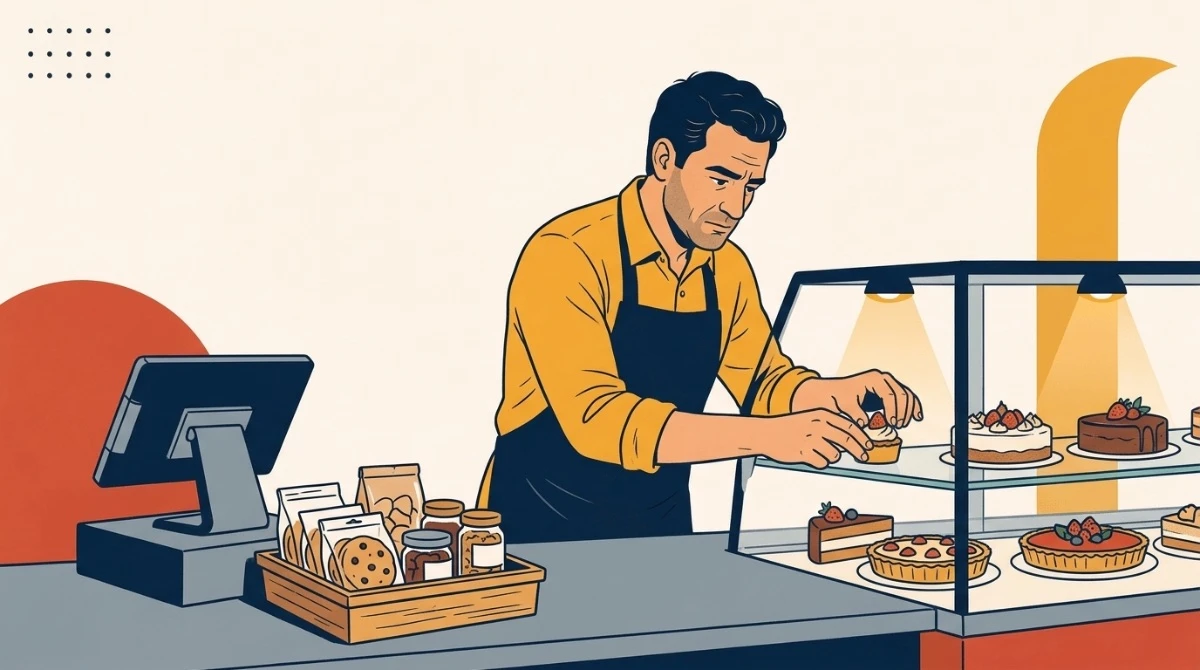
A guest walks up to the display counter. Do you think they read everything in the case, compare ingredients, and then make the smartest choice?
No. They glance for a few seconds. Their eye doesn't take in the whole display — it only lands on the first one or two points. These are called hot spots.
If your best-earning product sits in the bottom corner of the display, in a dark spot, it will wither away there. Put that same product in a hot spot, and it will sell more even if no one says a word.
1. Eye level — sales level
The old rule of retail: "eye level is buy level." People don't like looking up or bending down. An adult's eye line sits roughly 120–150 cm above the floor — that is the most valuable strip of the display.
- Put your highest-earning product in that strip. Not the most expensive — the highest-margin one.
- If you don't know which one is high-margin, first find your "star" products with the Menu Matrix.
- Lower shelves: cheap, fast-selling, commonly requested products — guests will look for those anyway.
About the right side: many sales consultants observe that the eye drifts from the centre to the right. Don't take this as law — test it. Keep a star product in the centre for 2 weeks, then centre-right for 2 weeks, and compare the sales.
2. The checkout: the impulse buy
The guest has placed the order and taken out their card. The decision is made, the resistance is down. At that moment, a small, cheap, easy-to-grab item near the till — a cookie, a pack of nuts, a small chocolate — easily becomes "add this too."
Rules:
- Don't put a big, heavy, expensive product by the till.
- Something bought on its own, that doesn't inflate the bill much, in the 1.5–3₼ range.
- Refresh it through the day: a small bun with the morning coffee, chocolate at midday, a dessert to take home in the evening.
Example calculation (plug in your own numbers): 300 receipts a day, 10% of them take a 2₼ item at the checkout → 60₼ a day, (30 days) 1,800₼ in extra turnover a month.
3. A display case that changes by the hour
However you arrange the display case in the morning, don't keep it that way until evening. As the parts of the day change, so should the product at the hot spot:
| Time | At the hot spot | Purpose |
|---|---|---|
| 08:00 | Fresh croissant, warm bun, coffee | A ready breakfast for the guest in a hurry |
| 12:30 | Set of the day, fresh salad, sandwich | To bring an undecided guest to an order quickly |
| 15:30 | Bright desserts, cheesecake, waffle | To sell dessert alongside coffee |
| 19:00 | Premium dessert, a glimpse of the signature dish | To grow the check and the experience |
Why these hours — in the Parts of the Day article.
4. Light: food is eaten with the eyes first
- Cold white or bluish light in the display case makes food look lifeless. Warm light (2700–3000K) brings out the golden color of the bun and the juices of the meat.
- Don't fill the whole display case with the same light. Aim a separate spot at the 2–3 star products — the eye goes to the brightest point.
- Light must not reflect in the glass — the guest would see the lamp, not the food.
We break down all the layers of light in a space in the 3-Layer Light article.
CHECKLIST — Look at your display case today
| # | Step | Status |
|---|---|---|
| 1 | Which product sits at eye level? Is it the highest-margin product? | ☐ |
| 2 | Star products are identified with the Menu Matrix | ☐ |
| 3 | The cold light in the display case has been replaced with warm light | ☐ |
| 4 | There is a 1.5–3₼ impulse-buy product next to the cash register | ☐ |
| 5 | Switching the display case to desserts at 15:00 has been assigned to the team | ☐ |
| 6 | A 4-week tracking schedule has been opened for the center / center-right test | ☐ |
📝 DOĞAN'S NOTE: "I've seen many who buy the most expensive display case and put a cheap cold lamp inside it. The dessert looks like it's been left over from last week. The restaurant business is the science of details — sometimes one lamp changes the whole display case."
💡 DK Agency: Which product is a star, which one makes a loss — Menu Matrix. For the waiter's sales at the table — The Waiter Doesn't Take Orders, He Sells.
🌐 dkagency.com.tr | 📍 Baku, Azerbaijan
Have a question about this?
If this situation sounds like your restaurant, write to us. The DK Agency team will reply.