Contents · 12 sections
- 1. The problem: shortage of trained and certified staff
- 2. The Turkish example: "Meslek Lisesi Memleket Meselesi"
- 3. What was the secret of the Koç model?
- 4. An opportunity for Azerbaijan: turning the workforce issue into a national system
- 5. TGTA: A practical translation of the Koç model for Azerbaijan
- 6. TİKA's role: an impact bigger than equipment
- 7. CTH cooperation: an international framework for local training
- 8. What falls to the business owner?
- 9. Economic Logic for the Business Owner
- 10. A Proposal for Azerbaijan: From the Sumqayit Model to a National Staff Platform
- Conclusion
- How does DK Agency help?
The complaint I hear most often from restaurant owners is this: "I can't find a good chef, a good waiter."
This sentence is not just one restaurant's problem. It is a structural problem of the entire HoReCa sector. Because there is staff on the market, but there is a shortage of systematically trained, measurable, certified and job-ready staff.
A restaurant hires a worker, trains them from scratch, the worker leaves, quality drops again. A hotel hires new personnel, gives the same training again. A café trains a barista, then that employee moves elsewhere. As a result, the owner constantly experiences the same problem: finding staff, training staff, retaining staff.
This problem cannot be solved only with salary, with an ad, or by "finding a worker through an acquaintance." Because the issue is not an individual worker's problem — it is the weakness of the vocational education system.
That is why this topic is no longer a matter of one restaurant, but of a sector; not of a sector, but of a country.
1. The problem: shortage of trained and certified staff
Why is service inconsistent?
Because a chef, waiter, barista, bartender, housekeeping employee and receptionist often do not undergo systematic vocational training before starting work. In many cases, a young person enters the job and begins learning the profession on the job.
And this creates three serious consequences:
- The owner spends time and money on every new employee.
- Service quality remains dependent on the employee's personal skill.
- Because there is no standardization, the guest experience is inconsistent.
In the restaurant and hotel business, the most dangerous situation is this: quality remaining tied to chance rather than to a system.
Good service one day, weak service another; good service in one branch, chaotic operations in another branch; a stable flavor with one chef, and a kitchen system that collapses when that chef leaves.
The root of this problem is not in the worker. The root problem lies in the fact that the system that trains them has not fully taken shape.
2. The Turkish example: "Meslek Lisesi Memleket Meselesi"
One of the strongest examples of a strategic approach to this topic in Türkiye is the "Meslek Lisesi Memleket Meselesi" program initiated by Koç Holding.
In 2006, Koç Holding, together with the Turkish Ministry of National Education and the Vehbi Koç Foundation, brought vocational education onto the agenda not merely as an education project, but as a core issue for the country's economic future.
The strength of this model was not only in the scholarships it provided. Its main strength was in building a system:
- Vocational schools were included in the process.
- Companies were linked with schools.
- Scholarships, mentorship and internship opportunities were created for students.
- A real bridge was built between the business world and the education system.
- Vocational education was removed from being a "second-rate choice" and presented as an important element of economic development.
According to Koç Holding's official information, the program covered 264 vocational schools and supported more than 8,000 students. Over time, the model took shape as the "School–Enterprise Cooperation" approach.
The main message was simple: A vocational school is not just the school's matter. It is the shared matter of industry, the state and society.
3. What was the secret of the Koç model?
What made the Koç model successful was not just the name of a large company. The model was built on three pillars:
The State
The state provides the school, the educational infrastructure and the official framework.
Industry
Companies provide the real work environment, internship opportunities, mentorship and future job prospects.
Foundation and corporate support
Scholarships, sustainability, project management and the social responsibility side are provided.
💡 Useful information: The strength of the Koç model lies in the state, industry and corporate support being tied to the same outcome. When these parties work separately, the impact remains limited; when they work together, what emerges is not a simple course but a national workforce development system.
This model is very valuable for Azerbaijan as well. Because the problem in our HoReCa and tourism sector is the same: the market is growing, restaurants are increasing, hotels are expanding, gastronomy tourism is coming onto the agenda, but the pool of job-ready personnel is not growing at the same pace.
4. An opportunity for Azerbaijan: turning the workforce issue into a national system
In Azerbaijan, the gastronomy and tourism sector has been gaining more strategic importance in recent years. The tourism potential of the regions, the promotion of local cuisine, gastronomy routes, service quality and the international guest experience are already becoming part of the country's brand.
But behind this brand stands people.
Even the most beautiful restaurant concept, the most expensive equipment, the best interior loses its value with poor service. For a guest, a brand is not just a logo; it is the waiter who greets them, the chef who prepares the food, the barista who serves the coffee, the housekeeping staff member who prepares the room, and the receptionist who creates the first impression.
For this reason, workforce development is no longer a secondary matter for Azerbaijan's tourism and gastronomy goals. It is a core infrastructure issue for the growth of the sector.
At this point, the Turan Gastro Tourism Academy — TGTA — established with TİKA support, stands out as a real and applicable model for Azerbaijan.
5. TGTA: A practical translation of the Koç model for Azerbaijan
The Turan Gastro Tourism Academy is a modern gastronomy and tourism education center established in Sumgayit. The academy operates on the training infrastructure and sector partnerships created with TİKA's support.
This is not just a course center. When managed correctly, TGTA can become the "School–Industry Cooperation Sumgayit Model" for Azerbaijan.
The main logic of the model is as follows:
- The student learns the profession not only through theory but in a real equipment and practical environment.
- Industry enterprises create internship and practical training opportunities for students.
- The employer becomes acquainted with ready and tested personnel.
- A young person who is unemployed or seeking a profession gains the skills the market demands.
- The academy, in turn, plays the role of a bridge between the sector and the state and the business world.
If this model is scaled up properly, it can start in Sumgayit and spread to Baku, Ganja, Sheki, Gabala, Lankaran, Naftalan and other tourism regions.
6. TİKA's role: an impact bigger than equipment
TİKA's role in this project should not be read merely as providing equipment. There is a more strategic matter here: the transfer of Türkiye's experience to Azerbaijan's vocational education system.
In the project approach, these directions come to the fore:
- Responding to the need for mid-level staff in the tourism and service sector.
- Equipping young people with job-ready skills.
- Creating practical training in fields such as culinary arts, waiting, barista work, housekeeping, reception and tourism services.
- Linking training with cooperation with employers and employment opportunities.
- Turning the model established in Sumqayıt into one that can also be applied to other regions.
This approach is very important. Because vocational education is not just teaching classes; it is a matter of employment, social development, sector quality and the regional economy.
The kitchen, training halls and practical training infrastructure established with TİKA's support are a beginning in this regard. The real value, however, lies in turning this infrastructure into a sustainable staffing system.
7. CTH cooperation: an international framework for local training
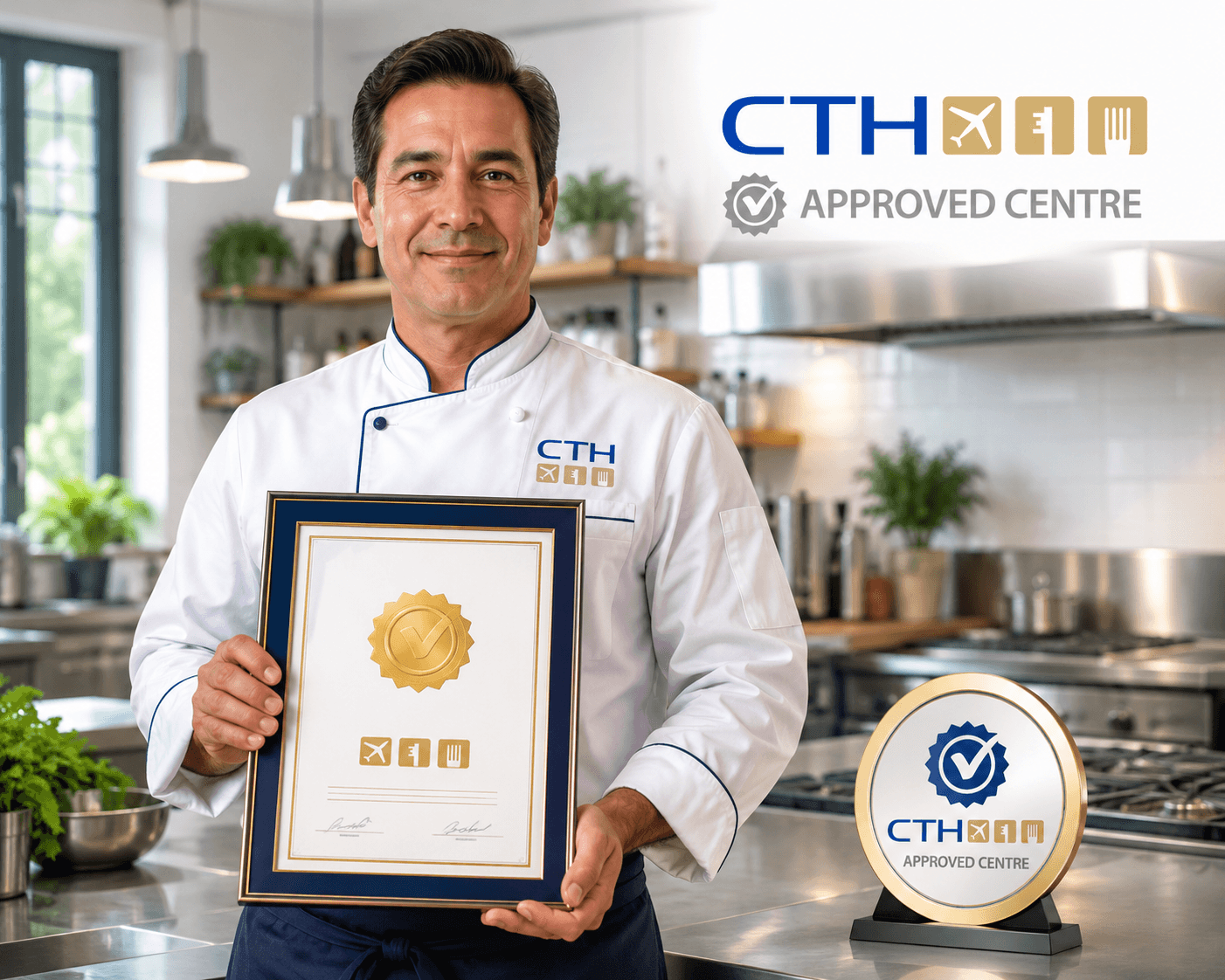
Another important advantage of TQTA is that it is a teaching center approved by CTH — the Confederation of Tourism and Hospitality.
This is important for Azerbaijan for two reasons.
First, local training aligns with international standards. This allows programs to be built not merely as a "local course," but as a more measurable system tied to quality.
Second, the value of the certificate increases for the graduate. The HoReCa and tourism sector is increasingly becoming a more mobile market. A good chef, a good barista and good hotel staff are in demand not only in one city, but across the country and in the international market as well.
In CTH's official center information, it is shown that TQTA offers programs in culinary arts, barista skills, restaurant service and tourism-hospitality English.
In this regard, the TQTA model should offer Azerbaijani youth not just a profession, but a career path.
8. What falls to the business owner?
Waiting for the state to build a large system is not the right approach. A business owner can become part of the process starting today.
1. Training staff systematically, not randomly
Leaving a new employee simply to "learn on the job" is not right. There should be a standard training plan for every position: introductory training, hygiene, product knowledge, service rules, sales skills, conduct with guests, complaint management and team discipline.
2. Cooperating with academies
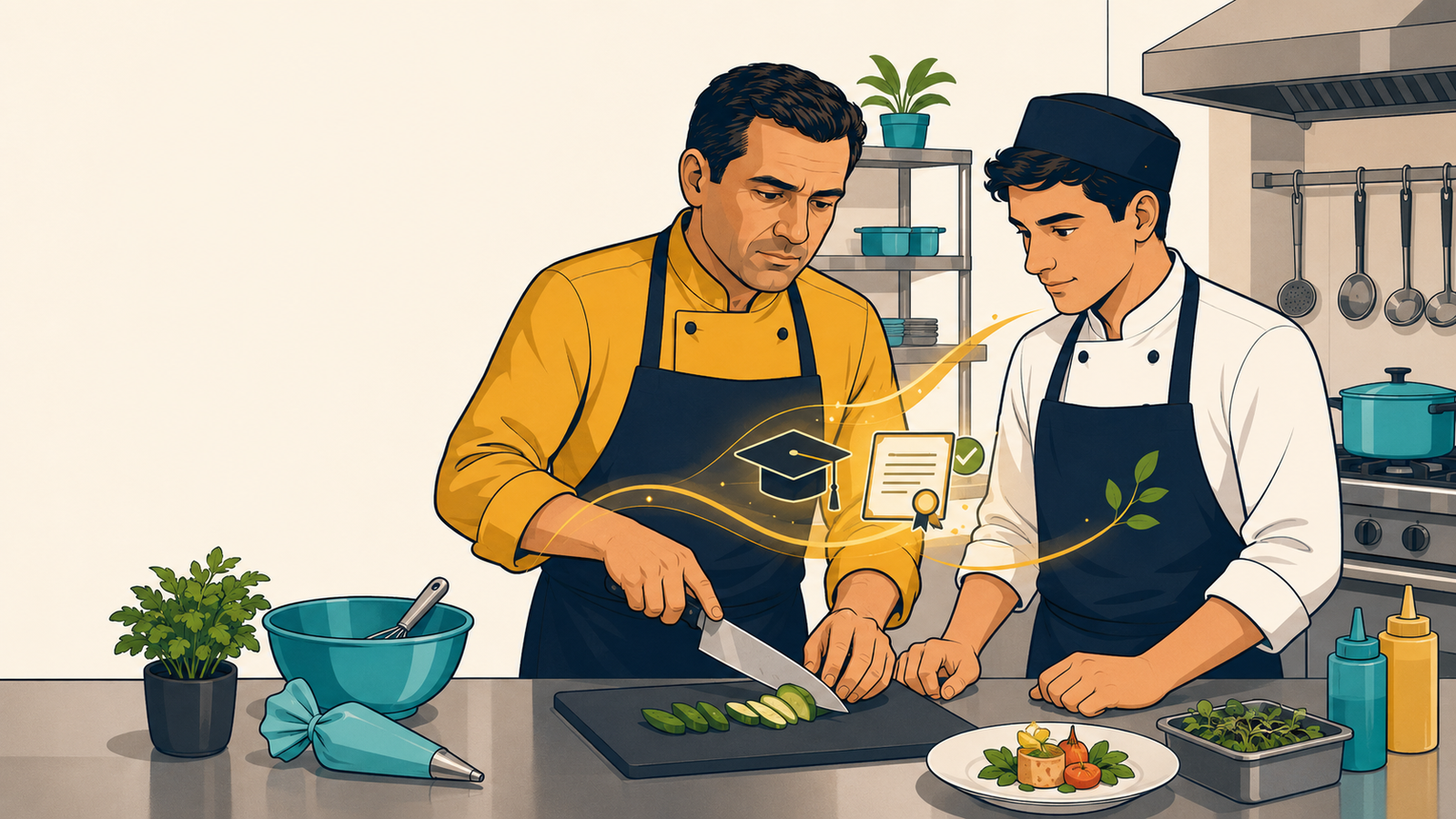
A business owner who cooperates with centers like TQTA both gains a pool of intern staff and gets the opportunity to get to know future employees in a real work environment. This reduces hiring risk.
3. Prioritizing certified staff
A certificate is not just paper. In the right system, a certificate shows that an employee has passed a certain standard. For a business owner, this serves as an initial filter in hiring.
💡 Practical result: Certified and trained staff create more stable service. Stable service means a more satisfied guest, repeat sales and a stronger brand.
9. Economic Logic for the Business Owner
Staff training is often seen as a cost. In reality, it is an investment that prevents hidden losses.
The costs that untrained staff create for a business owner are often invisible:
- A guest lost due to poor service.
- Wasted product.
- Incorrect portions and food cost problems.
- Complaints.
- Indiscipline within the team.
- The time a manager spends constantly solving the same problem.
- Weakening of brand reputation.
Trained staff, however, do not merely perform the job. They protect the system. They represent the brand the owner has built in front of the guest.
For this reason, staff training in the restaurant and hotel business is not a cost item, but a risk management tool.
10. A Proposal for Azerbaijan: From the Sumqayit Model to a National Staff Platform
The TQTA experience can be turned into a broader system. For this, the model must be built in stages.
First stage: The Sumqayit pilot model
TQTA's existing infrastructure, teaching kitchen, barista and bartender equipment, service training and tourism programs must be structured. Results must be measured for each program: how many students started, how many finished, how many completed an internship, how many were placed in jobs.
Second stage: Employer network
An official cooperation network must be established with restaurants, hotels, cafes, tourism companies and food production enterprises. Each enterprise must state in which field and how many interns and how many graduates it can accept.
Third stage: Certification and quality system
Training programs must not be limited to a certificate of attendance. Practical examination, a skills matrix, job-readiness assessment and behavioral standards must also be measured.
Fourth stage: Regional expansion
After Sumqayit, the model can be adapted to regions with tourism potential. The needs of each region differ: in Naftalan, health tourism personnel, in Gabala, hotel and service staff, in Shaki, local gastronomy, in Lankaran, regional cuisine and tourism guiding may come to the fore.
Fifth stage: Digital staff platform
Graduates' portfolios, certificates, the enterprises where they interned, their skill level and job suitability must be tracked in a digital system. This will speed up the hiring process for the business owner and make results measurable for the academy.
Conclusion
The HoReCa and tourism sector in Azerbaijan is growing. But new restaurants, new hotels and new concepts alone are not enough for the sector to grow. Behind this growth there must be systematically developed human capital.
This is the main lesson the coach model has demonstrated in Turkey: vocational education is not the school's job alone. The state, industry, foundation, academy and business owner must work together.
The TQTA established in Sumqayit with TIKA support is, in this regard, a real starting point for Azerbaijan. If this model is managed correctly, it can become the core of a nationwide staff training system, not just a single academy.
The root of service is in the staff. The root of staff is in education. And the strength of education is in the system.
How does DK Agency help?
DK Agency and TQTA — Turan Gastronomy Tourism Academy — work to develop trained, certified and job-ready personnel in the HoReCa and tourism sector.
Our approach is simple: personnel are not an expense, they are the foundation of the brand.
TQTA prepares young people and existing sector employees for work through practical training programs in culinary arts, confectionery, waitstaff service, barista, bartending, housekeeping, reception, tourism and service fields. DK Agency, in turn, supports entrepreneurs in integrating this personnel system into restaurant, cafe and hotel operations.
Our goal is not merely to deliver courses. Our goal is to build a measurable, sustainable and certified personnel ecosystem in Azerbaijan's HoReCa sector.
Next step: If you want to develop your team systematically and join a pool of job-ready personnel, contact DK Agency / TQTA for training programs.
Source note: Official statements of Koç Holding's "Meslek Lisesi Memleket Meselesi" program; CTH's TQTA Approved Teaching Centre information; TQTA and TİKA-supported academy materials.
How DK Agency helps
If what this post describes is happening in your restaurant, café or hotel, write to us: we will look at it together and show you the first step. The first diagnostic is free.
Ask KAZAN AI about this topic
Your dish, your numbers. KAZAN AI answers from the DK knowledge base and points you to the right tool.
Open KAZAN AI