
Contents · 8 sections
- Legal due diligence guide for investors (preliminary review)
- 1. Why is Article 726 important for an investor?
- 2. There are 3 parties in a franchise transfer
- 3. Which documents should the investor see?
- 4. How should the price be formed?
- 5. Recommended transfer model for Azerbaijan
- Conclusion
- How does DK Agency help?
Legal due diligence guide for investors (preliminary review)
Franchise transfer is not just buying a ready-made business. Three assets are transferred together here: the right to use the brand, a working operating system, and future cash flow. Therefore, the transfer should be conducted not as a simple purchase and sale, but as a process in which legal, financial and operational risks are reviewed together.
In Azerbaijan, the legal basis for this topic is the franchising provisions of the Civil Code: the parties must disclose to each other the terms related to the franchise system openly and honestly, and must protect the confidential information they obtain even if no contract is concluded.
This article shows one thing: concealing information in franchise negotiations is not only an ethical problem, but a legal risk.
1. Why is Article 726 important for an investor?
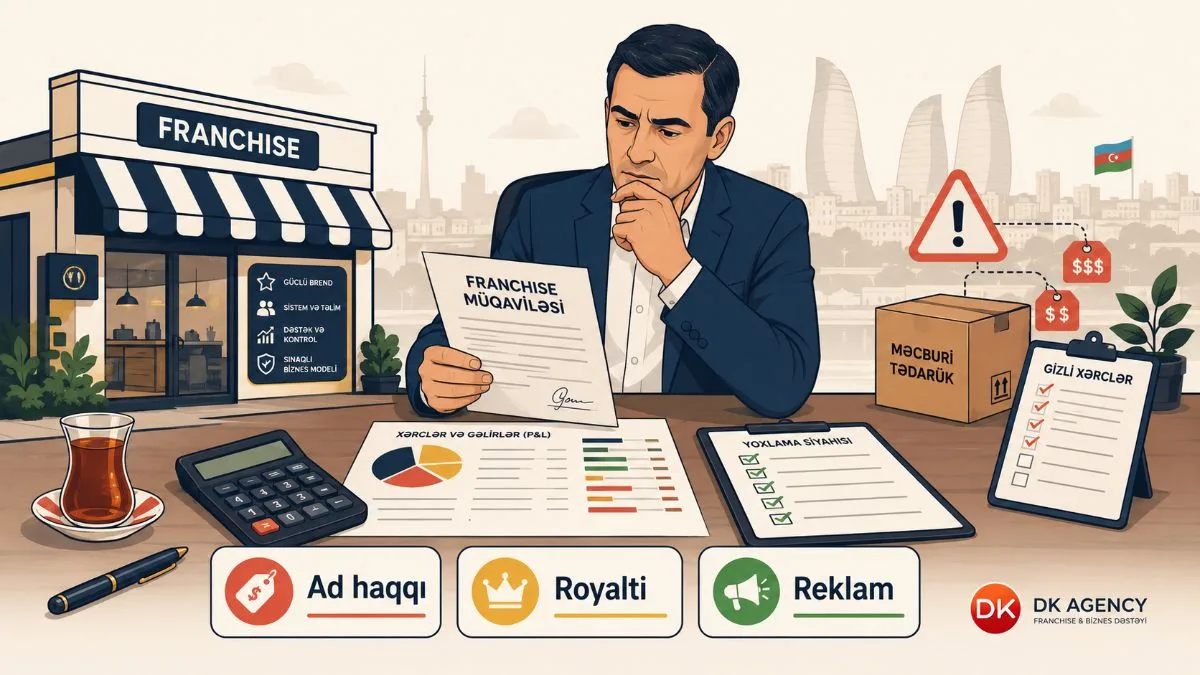
An investor often relies on the seller's figures. If this information is not complete and transparent, a wrong decision may be made. For example: if the seller hides the real food cost, if the POS data does not match the tax turnover, if the franchisor does not disclose a royalty increase, if the lease contains a risky termination clause, if territorial protection does not actually exist, or if the franchisor's written consent is required for the transfer but this is not disclosed.
Legal risk box
The most dangerous sentence in a franchise transfer is this: "We'll discuss this later." At the due diligence stage, there is no "later" — everything must be in writing, documented and measurable before the contract.
2. There are 3 parties in a franchise transfer
An ordinary business sale has two parties. In a franchise transfer, there are actually three parties: the selling franchisee, the buying investor, and the franchisor brand. Their interests are not the same — the seller wants a high price, the buyer wants low risk, and the brand wants continuity and standards.
Therefore, agreeing only with the seller is not enough. The brand owner's consent to the transfer, approval of the new buyer, training obligations and the contract term must be checked separately.
3. Which documents should the investor see?
Financial: POS sales for the last 12–24 months, tax declarations, bank transactions, profit/loss statements, supplier debts, payroll, royalty/advertising payments, delivery commissions, utilities/rent.
Legal: franchise agreement, transfer permission clause, brand use terms, territorial protection, contract expiry date, termination/renewal, lease agreement, licenses, employee and supplier contracts.
Operational: menu/recipe cards, food cost cards, inventory counting procedure, training materials, hygiene procedures, customer base, online sales reports.
Useful information box
The seller says "everything is in order with us," but if they cannot provide documents — this is a red flag. It is not the restaurant's walls that should speak, but its documents.
4. How should the price be formed?
The price should be calculated not with the logic of "I have spent this much on this property," but with the question "how much net profit will this business generate in the future?" The following should be taken into account: EBITDA for the last 12 months and its repeatability, rent/turnover ratio, food cost stability, remaining term of the contract, the franchisor's attitude toward the transfer, future investment requirements, and multi-unit expansion potential.
Red flags
- Sales data is presented only verbally
- Tax turnover differs significantly from POS data
- The lease term is shorter than the franchise agreement
- There is no written consent from the franchisor for the transfer
- The head chef/manager wants to leave
- Food cost has been artificially understated in recent months
- Debts are not fully disclosed
5. Recommended transfer model for Azerbaijan
- NDA + preliminary information package (the NDA makes confidentiality written and specific)
- Preliminary consent of the franchisor
- Financial due diligence (POS, tax, bank, debts)
- Legal due diligence (franchise, lease, labor, license)
- Operational audit (kitchen, service, team, food cost)
- Valuation and conditional offer (EBITDA + risk-based)
- Transfer agreement and transition plan (the seller provides support for a certain period)
Conclusion
Law and finance should not be considered separately: even the best sales data loses value with a weak contract. The message of M.726 is clear — the parties must inform each other fully, honestly, and in a timely manner.
Final investor question
"Am I seeing only the good sides of this business, or can I measure all its risks on paper?" If risks are measurable, the price is negotiable. If risks are hidden, there is no price — there is danger.
Useful tools
How does DK Agency help?
With its Transfer platform and franchise consulting, DK Agency systematizes the legal and financial pre-check of a transfer. The Badge of Mastery, the Barrier of the Digital.
Next step: Thinking of a transfer? Contact DK Agency for a free preliminary valuation.
Note: This article is for general information purposes and is not legal advice. Consult a lawyer for specific steps.
This article is for general informational purposes and does not constitute legal advice. For specific steps, consult a patent attorney or lawyer.
How DK Agency helps
If what this post describes is happening in your restaurant, café or hotel, write to us: we will look at it together and show you the first step. The first diagnostic is free.
Ask KAZAN AI about this topic
Your dish, your numbers. KAZAN AI answers from the DK knowledge base and points you to the right tool.
Open KAZAN AI