
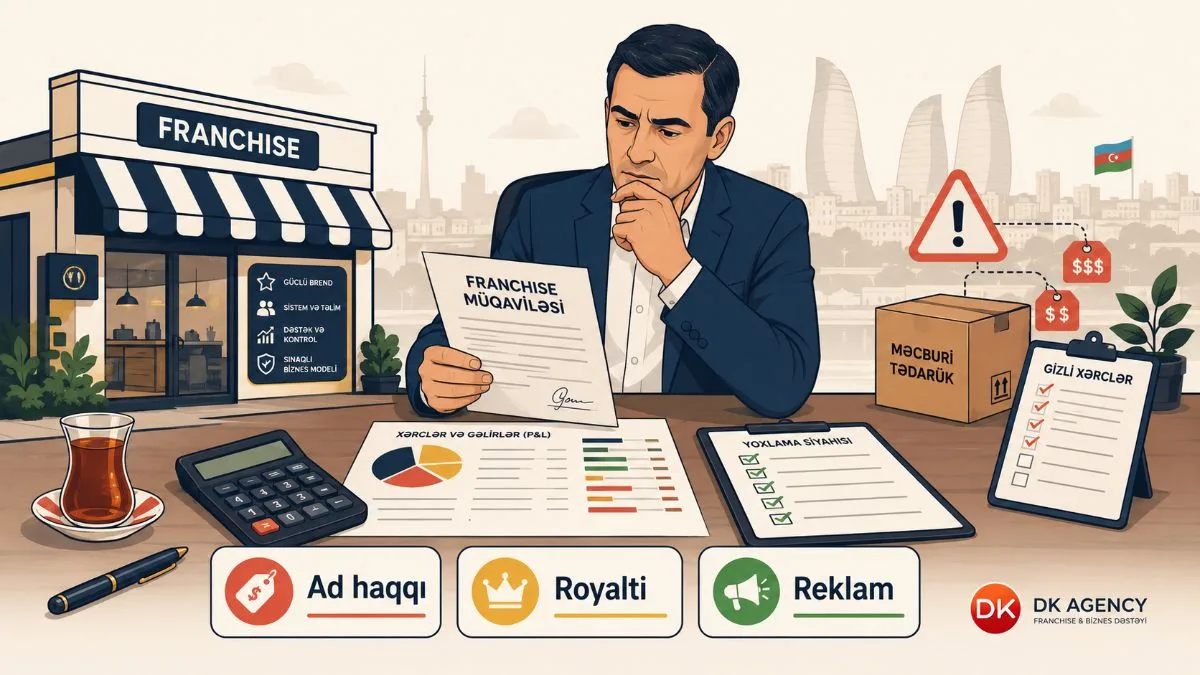
An entrepreneur who wants to buy a franchise usually faces three main fees: initial franchise fee, royalty, and advertising fee.
Many entrepreneurs look at these figures separately: “How much is the initial franchise fee?” “What percentage is the royalty?” “Is there an advertising fee?”
The real question is different: in return for these payments, are you getting a working system, or are you simply renting the brand’s name?
In a franchise model, fees are normal. The problem is not paying fees; the problem is a fee that has no return, is not transparently explained, and is not fully visible in the contract.
This article helps you read franchise payments not through an entrepreneur’s eyes, but through an investor’s eyes.
- Initial franchise fee — not an entry ticket at the door, but a fee for entering the system
The initial franchise fee is a one-time amount paid when entering a franchise system. It is sometimes also shown as an “entry fee,” “franchise fee,” or “initial fee.”
This amount should not be paid just to hang the brand’s sign. In a healthy franchise model, the initial franchise fee must come with a specific package:
initial training; pre-opening support; operations manual; menu and product standards; staff training; location selection and opening plan; system, software, and reporting structure; initial post-opening supervision.
In other words, the entrepreneur should buy a working operating model, not just a name.
If the brand asks for a large initial fee but cannot give a specific answer to the question “What is included?”, that is already a risk signal.
DK view
The initial franchise fee should be read not as a standalone number, but as the price of a system transfer. An expensive initial fee is not bad; an initial fee with no return is bad.
- Royalty — an ongoing partnership fee
Royalty is a recurring fee that the franchisee regularly pays to the franchisor. It is usually calculated as a certain percentage of monthly turnover.
For example, if a restaurant generates 100,000 AZN in monthly turnover and the royalty is 5%, the franchisee pays 5,000 AZN in royalty.
What is the royalty paid for?
protection of brand strength; ongoing operational support; product and menu innovations; training and audit; technology and system development; network growth; protection of standards.
In the healthiest model, the franchisor’s income is tied to the franchisee’s success. That is, as the franchisee grows, the franchisor grows too.
But there is a critical difference here: percentage-based royalty and fixed royalty.
Percentage-based royalty is tied to turnover. If turnover falls, the payment also falls. A fixed royalty, however, remains the same regardless of sales. This model can work in some cases, but it can squeeze the franchisee during a weak location, a seasonal downturn, or the heavy expenses of the first months.
Ask before the contract
Is the royalty calculated on turnover or net profit? Is there a minimum royalty? Is it paid in loss-making months as well? Which services are included in the royalty? What ongoing support does the franchisor provide in return for this payment?
- Advertising fee — a shared fund or an invisible cost?
The advertising fee is a fund collected for the network’s shared marketing expenses. It is usually calculated as a small percentage of turnover.
The logic of this fund is correct: advertising that a single entrepreneur cannot do is done by the entire network together. The brand gains visibility, customer traffic increases, and campaigns are managed centrally.
But the main issue here is transparency.
A good franchisor explains how the advertising fund is spent. Which campaigns were run, which channels were funded, and how they affected franchisees’ sales — these must be measured.
In a weak model, the advertising fee is collected but no report is provided. The franchisee pays money and does not see the result.
The right question
The question “What percentage is the advertising fee?” is not enough.
The right question is this: how is this fund managed, who decides, and how is it reported?
- The hidden fee trap: cheap royalty, expensive mandatory purchases
In some franchise models, the initial fee is shown as low and the royalty as low too. At first glance, it looks like an opportunity.
But then it turns out that the franchisee must buy all products, packaging, raw materials, equipment, and software only from the source designated by the franchisor. Sometimes these products are significantly more expensive than the market price.
In such cases, the franchisor earns not from royalty but from mandatory product sales.
This is one of the most dangerous traps for a franchisee. Because when the entrepreneur looks at the contract, the royalty seems low, but when looking at the P&L, they realize that the real margin is melting away.
Key rule
Calculate franchise fees not separately, but together:
Initial fee + royalty + advertising fee + mandatory purchases + software cost + audit cost + renewal cost + hidden margin
The real burden appears in this total.
A low royalty is sometimes not cheapness, but simply money taken from a different place.
- Is a “fee-free franchise” truly fee-free?
There are also models on the market that say “no initial fee,” “no royalty.” This looks especially attractive to a small-budget entrepreneur.
But in business, a fee-free model is very rarely truly fee-free.
In such models, profit usually comes from three places:
from products sold to the franchisee; from a monthly minimum sales target; from a mandatory purchasing system.
This model is not a bad model. It may even be very suitable for some sectors. But the question does not change:
Is the product price fair compared to the market? Is the sales target realistic? Does the mandatory purchase kill the franchisee’s margin?
If the product price is much higher than the market, the phrase “no royalty” should not deceive the entrepreneur. The royalty may simply be hidden inside the product.
- How should franchise fees be read like an investor?
Buying a franchise is not an emotional decision. “The brand is famous,” “its logo is strong,” “everyone knows it” — these are not enough.
An investor looks at a franchise offer with three questions:
- Does this system reduce my risk?
The main promise of a franchise is this: you are not learning from scratch; you are entering a proven system. If the system still leaves you alone, the point of buying a franchise decreases.
- Do these fees protect my margin?
In the restaurant and cafe business, turnover may look large, but net profit is thin. After food cost, wages, rent, utilities, taxes, and platform commissions are deducted, royalty and advertising fees have a serious impact on real profit.
- Does the franchisor earn from my success?
In the healthiest model, the franchisor does not earn only at the moment of sale. It earns as the franchisee grows. This aligns the parties’ interests in the same direction.
If the franchisor earns the main money from the entry fee and mandatory product sales, its interest in your long-term success may weaken.
- 10 questions before the contract
Before signing the franchise agreement, these questions must be answered in writing:
What exactly is included in the initial fee? How many days does training last, and for whom is it mandatory? Is there pre-opening and post-opening support? Is the royalty percentage-based or a fixed amount? Is there a minimum royalty obligation? How is the advertising fund spent, and is it reported? Is there mandatory purchase of goods and equipment? Are mandatory purchase prices fair compared to the market? Is there a renewal fee when the contract term ends? If the franchisee wants to exit the contract, what terms apply?
The answers to these questions must be written, not verbal.
In franchising, a verbal promise is a risk. A written obligation is the beginning of due diligence.
Conclusion
The initial fee, royalty, and advertising fee are a normal part of the franchise system. When structured correctly, these fees reduce the franchisee’s risk, protect the brand’s strength, and serve the network’s growth.
But if there is no transparency, the same fees become a burden for the entrepreneur.
When looking at a franchise offer, do not ask only “what percentage is it?” Look deeper:
What am I paying for? What do I get in return? How does this payment change my margin? Does the franchisor earn from my success? Where are the hidden costs?
A correct franchise model does not create costs; it gives the entrepreneur the system that would be difficult to build alone, ready-made.
How does DK Agency help?
Before a franchise agreement, DK Agency evaluates the fee structure, hidden costs, mandatory purchases, and contract terms on behalf of the entrepreneur.
We do not view
Michael H. Seid approach
“In the franchising world, the name Michael H. Seid is no accident. He is the founder of MSA Worldwide, an international franchise consultant, and one of the co-authors of “Franchising for Dummies.” The main lesson of Seid's line is simple: the franchise decision should be made based not on the sales presentation, but on the document, system, and real franchisee experience. In other words, a franchisor can give you a beautiful presentation. But the real truth appears in three places: in the contract; in the financial model; in what existing franchisees say. If a brand tells you “we provide a lot of support,” ask for it not as a sentence but as proof: training plan, audit system, opening support, advertising report, purchasing terms, real franchisee results. When buying a franchise, the goal is not to find the cheapest package. The goal is to get a measurable return for every cost you pay.”
DK AGENCY NOTE
Legal note: This article is for general informational purposes and does not constitute legal advice. For specific steps, consult a patent attorney or lawyer.