Contents · 8 sections
- Risk, cash flow and EBITDA outlook in the 2026 market
- 1. Greenfield setup (that is, building from scratch): a nice idea, high uncertainty
- 2. Operating franchise transfer: the "real data" advantage
- 3. When does the money start working? (Time-to-Money)
- 4. What does EBITDA say?
- 5. Why is takeover relevant in the Azerbaijani market?
- Conclusion: not romance, but a measurable investment
- How does DK Agency help?
Risk, cash flow and EBITDA outlook in the 2026 market
In 2026, investment decisions in the HoReCa sector are no longer made with the mindset of "let's open a nice place." Rental costs, wage pressure, food cost fluctuations, equipment prices and more selective consumer behaviour have turned restaurant investment into a technical decision.
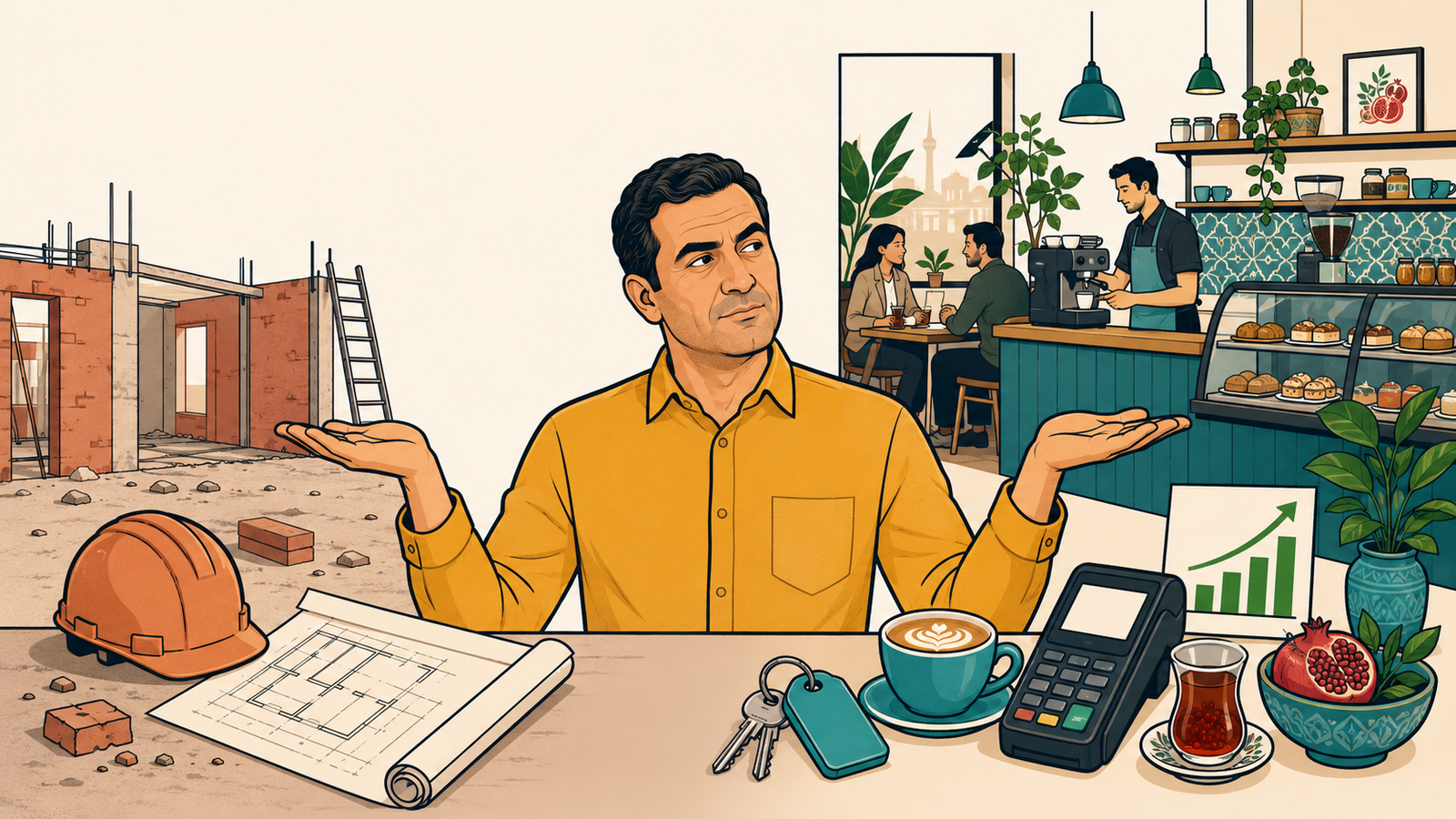
In this market, the key question for an investor has changed: "Am I building a brand, or am I buying an already operating cash flow?"
Building a restaurant from scratch is still possible, but it carries high uncertainty. Taking over an operating franchise branch, when analysed correctly, creates more measurable, faster-to-test and quicker-payback potential. The point is not just buying a restaurant — it is calculating the price of risk correctly.
1. Greenfield setup (that is, building from scratch): a nice idea, high uncertainty
First, initial investment risk (CAPEX). Construction, decoration, kitchen equipment, ventilation, POS system, furniture, facade — the budget planned on paper can increase considerably close to opening.
Second, time risk. If the venue is not open, the money is not working. The investor puts in capital, but for 3–6 months there are no sales. During this period, rent, the team, design changes and licences tie up capital in "dead time."
Third, market-fit risk. Location, menu, price and speed of service are only truly tested after opening. A pre-opening Excel model does not fully reflect market behaviour.
Investor box
The key question in greenfield investment: "Do we believe this concept will work, or is there real sales data proving it?" If the answer is only "we believe," this is not an investment but a high-risk concept test.
2. Operating franchise transfer: the "real data" advantage
When taking over an operating branch, the investor does not build a kitchen from scratch, does not search for a team, does not guess customer behaviour — they step into an already functioning system. They can sit down at the table with this data: sales for the last 12–24 months, food cost, wage burden, rent-to-turnover ratio, customer repeat rate, share of online sales, average ticket, EBITDA margin, seasonal fluctuations and tax history.
This reduces risk — because the decision is based not on "future probability" but on past performance.
Useful information box
In an operating franchise transfer, the investor is not just buying equipment. They are buying: a proven location, a ready customer base, trained staff, established supply, brand recognition, daily cash flow and measurable EBITDA. In other words, they are paying for a working economic unit, not a physical space.
Guru Box
Warren Buffett: "Price is what you pay, value is what you get." (For the investor: what matters is not the sale price, but the real profit the business generates.)
3. When does the money start working? (Time-to-Money)
In a restaurant built from scratch, money first goes into the project, construction, the team and the opening; sales begin only after all of this. In an operating transfer, however, sales continue from day one — customers come in, the POS is running, the team is serving. This difference has a serious impact on the payback period.
Simple comparison
| Criterion | Investment from scratch | Operating franchise turnover |
|---|---|---|
| Start of sales | After opening (months) | From day one |
| Initial cost deviation | High | Low |
| Team risk | High | Medium/low |
| Customer data | None | Available |
| Food cost history | None | Available |
| EBITDA analysis | Projection | Actual result |
| Bank/credit view | Riskier | More measurable |
| Exit potential | Concept must be proven | Performance can be proven |
4. What does EBITDA say?
EBITDA (that is, operating profit before interest, tax and amortization) is the true health indicator of a restaurant. High turnover does not always mean a healthy business: a restaurant can turn over 100,000 AZN, but if food cost, payroll and rent are not right, the real profit remains weak.
EBITDA checklist
Ask these questions before the takeover:
- Over the last 12 months, is EBITDA stable, or has it been inflated by the effect of a few months?
- How was the margin protected when food cost rose?
- How much will EBITDA decrease when the rent is renewed?
- Have royalty and the advertising fund been fully taken into account?
- Have the owner's personal expenses been cleaned out of the profit/loss statement?
- Have delivery commissions been calculated realistically?
5. Why is takeover relevant in the Azerbaijani market?
There are three parallel processes: good locations are limited and rent is rising; the consumer now looks at speed, taste consistency and price balance; some entrepreneurs build a good concept but remain weak in financial management and systematization. The last one is an opportunity for the investor — to buy a poorly managed but promising business and grow it with a system.
During a takeover, three areas must be analyzed separately: legal compliance (contract, takeover permit, territorial protection, termination), financial transparency (POS, tax, bank, debts), operational continuity (team, kitchen standards, supply).
Conclusion: not romance, but a measurable investment
For the investor, the question is simple: "When and with what risk will this capital return?" An operating franchise takeover, when carried out with proper due diligence, is the more rational choice — here you buy performance, not an idea; cash flow, not decor.
Final investor box
The last question before the takeover: "Does this business work without me?" If the answer is yes, this is no longer a restaurant — it is an investment asset.
Useful tool
How does DK Agency help?
DK Agency's takeover listings show operating franchises and businesses in one place; before deciding, check the numbers with the ROI Calculator. The Badge of Mastery, the Shield of the Digital.
Next step: Look at the takeover platform or calculate your own numbers with the ROI Calculator.
How DK Agency helps
If what this post describes is happening in your restaurant, café or hotel, write to us: we will look at it together and show you the first step. The first diagnostic is free.
Ask KAZAN AI about this topic
Your dish, your numbers. KAZAN AI answers from the DK knowledge base and points you to the right tool.
Open KAZAN AI