Contents · 6 sections
Why is the name "Antep baklava" so valuable in the world? Because this name is protected. Only those who produce it in Gaziantep, using a specific method, can use it. This protection turns the product from an ordinary sweet into an international brand.
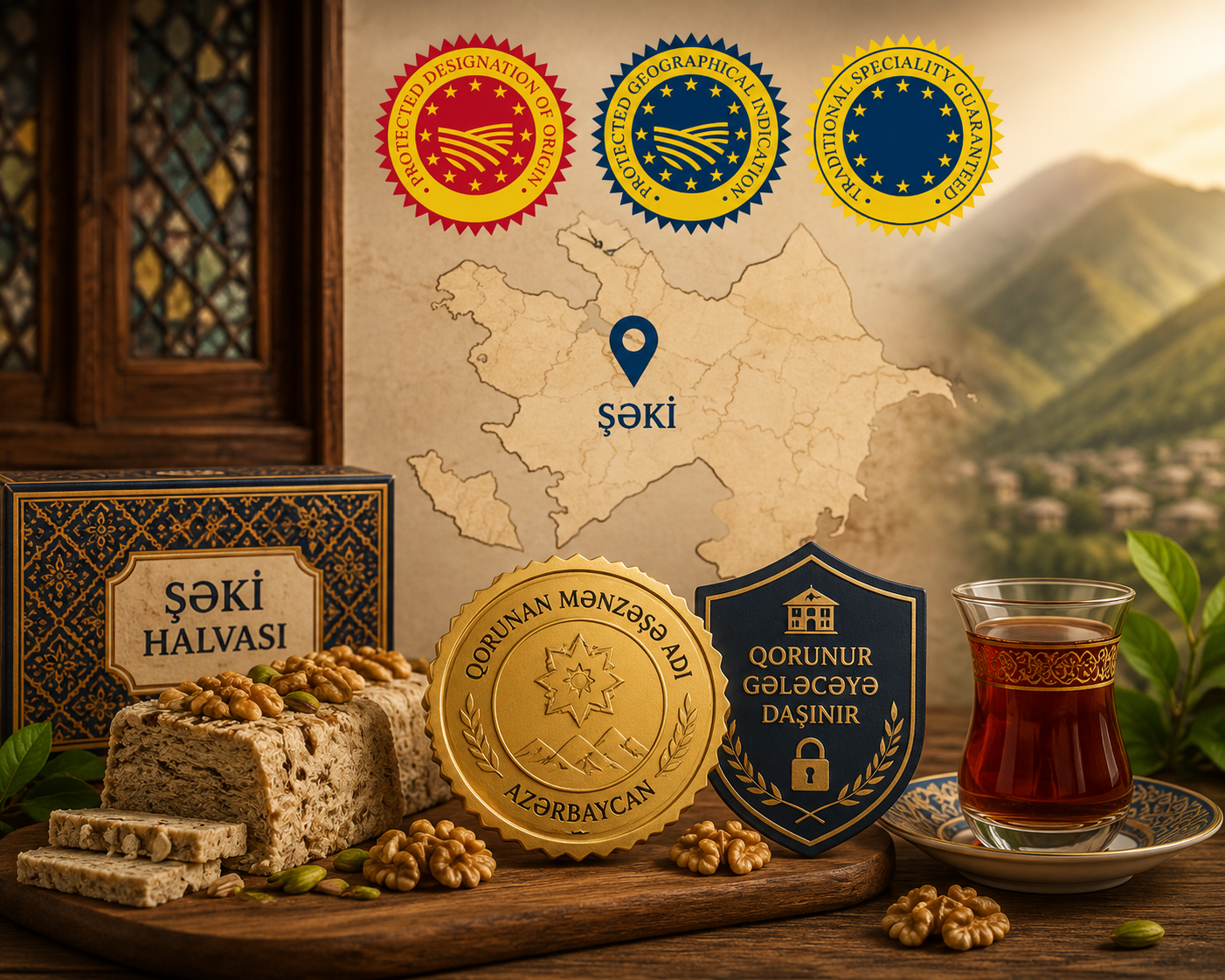
Azerbaijan also has such treasures — Sheki halva, Guba apple, Lankaran tea, Absheron saffron. The question is: can we also protect them and turn them into gold?
1. What is a geographical indication?
A geographical indication — is the legal protection of a product's name linked to a specific place. That is, only a person producing in Sheki, using the traditional method, can use the name "Sheki halva". Halva prepared in another region cannot be sold under the name "Sheki halva".
This is not just a legal formality — it is a mechanism that protects a region's flavor, labor and name from appropriation.
2. The Turkish example: when the name is protected, value increases
Türkiye is a world example on this path. Today there are more than a thousand registered geographical indications in Türkiye; the city of Gaziantep alone has more than a hundred registered products. The most iconic is Antep baklava — it became the first Turkish product registered in the European Union.
What was the result? When the name is protected:
- Imitation decreased, the value of the genuine product increased.
- The export price rose — a "protected name" means money in the international market.
- The region became attractive for tourism — people came to "taste the original on site".
In one sentence: a geographical indication turns a product from "cheap food" into a "protected brand".
3. The opportunity for Azerbaijan
The good news: Azerbaijan has already taken action in this direction. In strategic approaches to gastronomy tourism, increasing geographical indication registrations is one of the main directions. Registration is carried out by the Intellectual Property Agency.
Examples of potential candidates: Sheki halva, Guba apple, Lankaran tea, Absheron saffron.
╔══════════════════════════════════════════════════════════╗ ║ 💡 WHAT DOES A GEOGRAPHICAL INDICATION GAIN ITS OWNER? ║ ║ ║ ║ 1. Legal protection from imitation ║ ║ 2. A higher sale price ║ ║ 3. Export advantage ║ ║ 4. Tourism attraction ("taste the original on site") ║ ║ 5. Recognition of the region as a whole brand ║ ║ ║ ║ 🔗 One product — five benefits. ║ ╚══════════════════════════════════════════════════════════╝
4. Practical meaning for the producer/entrepreneur
If you produce a traditional product in a specific region, a geographical indication is for you:
- A shield — no one else can appropriate your name.
- Pricing power — a "protected genuine product" sells for more.
- A tourism magnet — the gastro tourist seeks the genuine product on site, comes to your region.
So a geographical indication is not just a piece of paper — it is a tool that revitalizes the region's economy.
5. How to apply? (brief)
The application is made to the Intellectual Property Agency; the product is registered as a "designation of origin" or a "geographical indication." The process requires documenting the connection with the region, the production method, and the tradition. This is often carried out not by an individual but by an association of producers in the region.
Conclusion
A geographical indication is a mechanism that turns local flavor into gold. Türkiye proved this; Azerbaijan, with state support, has set out on the same path. If you produce a traditional product in a region, protecting its name is the first step toward turning it into an international brand.
💡 DK Agency: Thinking about protecting your local product or brand? Get in touch with DK Agency for a free preliminary assessment.
📧 info@dkagency.com.tr | 🌐 Contact
Source: T.R. geographical indication registration statistics; Strategic Development Plan for Gastronomy Tourism of the Republic of Azerbaijan (2025-2030); Intellectual Property Agency. This article is general information, not legal advice.
This article is for general informational purposes and does not constitute legal advice. For specific steps, consult a patent attorney or lawyer.
How DK Agency helps
If what this post describes is happening in your restaurant, café or hotel, write to us: we will look at it together and show you the first step. The first diagnostic is free.
Ask KAZAN AI about this topic
Your dish, your numbers. KAZAN AI answers from the DK knowledge base and points you to the right tool.
Open KAZAN AI