Contents · 11 sections
- 1. Gastronomy is no longer just food — it is a country brand
- 2. Four major goals: a signal for the entrepreneur
- 3. The "Five Senses" approach: selling an experience, not just food
- 4. Street food: a big opportunity for small business
- 5. Geographical indication: the legal and commercial value of a local product
- 6. Certification: a selection criterion in the market of the future
- 7. Staff training: the most critical part of the plan
- 8. Public–private sector cooperation: you need to be at the table
- 9. What should the business owner do today?
- Conclusion
- How does DK Agency help?
Azerbaijani gastronomy is no longer just a matter of "delicious cuisine." This field is turning into a strategic direction directly linked to tourism, exports, local products, workforce training, regional development, and the country's brand.
From this perspective, the "Gastronomy Tourism Strategic Development Plan (2025–2030)" document should be read as an important roadmap for the sector. The document can be regarded as an action framework that aligns with the strategic goals announced by the State Tourism Agency and calls on public–private sector cooperation, associations, entrepreneurs, and educational institutions to think around the same table.
In this article, we look at the document through the eyes of an entrepreneur: what does this roadmap mean for a business operating a restaurant, hotel, café, local product manufacturing, or tourism service?
1. Gastronomy is no longer just food — it is a country brand
The core philosophy of the plan is simple: Azerbaijani cuisine must be presented not only as table culture but as a global tourism product.
This approach is very important for the entrepreneur. Because in the future, competition in the gastronomy field will not be based only on "delicious food." Competition will be broader:
- the story of the product,
- service standards,
- guest experience,
- connection to local heritage,
- certification and quality systems,
- digital visibility,
- international recognition.
In other words, the gastronomy business of the future will be built not only in the kitchen, but on brand, experience, and systems.
2. Four major goals: a signal for the entrepreneur
The document sets ambitious and measurable goals through 2030:
- internationally recognized restaurant quality
- increased geographical indication registrations
- certification of establishments
- raising the professional level of employees
These figures are not just macro goals. Each one is a separate door of opportunity for the entrepreneur.
The Michelin goal tells restaurants that service, product, presentation, and consistent quality at an international level are now on the agenda.
The geographical indication goal tells local product manufacturers that Sheki halva, Lankaran tea, Karabakh cuisine, regional cheeses, jams, honey, and other local values can become not just products but protected brands.
The certification goal tells the HoReCa entrepreneur that an establishment with standards will hold a stronger position in the future market.
And raising the professional level of 290,000 employees touches the sector's most painful spot: workforce.
💡 Useful information: When reading this roadmap, it is necessary to keep 4 directions in mind: quality, geographical indication, certification, and workforce. These are not just statistical indicators; for the entrepreneur, they are the direction for future investment, training, certification, and brand decisions.
3. The "Five Senses" approach: selling an experience, not just food
One of the most interesting aspects of the plan is that it builds gastronomy tourism around the five senses: taste, smell, sight, sound and touch.
This approach is very valuable for restaurant and tourism entrepreneurs. Because the modern tourist does not just want to eat. They seek a story, an atmosphere, a culture and a memory.
For example, Lankaran tea is not just a drink served in a glass. It can become a complete experience together with the scent of the tea plantation, the shape of the armudu glass, the sound of the samovar, the touch of the tea leaf and the visual culture of the table.
The same logic applies to Sheki halva, Guba apples, Karabakh cuisine, Nakhchivan products, Absheron traditions and Baku restaurant concepts.
The takeaway for the entrepreneur is simple: Don't just sell food. Design an experience.
4. Street food: a big opportunity for small business
One of the fastest-growing areas of gastronomy tourism is street food. Gutab, tandir bread, doner, perashki, dushbara, varieties of gutab, sweets and regional snacks can become a tourism product when properly standardized.
But three conditions are essential for this:
- hygiene,
- a standard recipe and portion,
- proper brand presentation.
Even a small vendor can become an interesting stop for an international tourist once these three issues are addressed. The opportunity here is not only in large restaurants. On the contrary, a big door opens for local and small businesses too.
The message for the entrepreneur is this: Don't just sell a traditional product — standardize it, package it, give it a story and make it visible.
5. Geographical indication: the legal and commercial value of a local product
One of the main directions of the plan is the increase of geographical indications. This is a very strategic topic for the entrepreneur.
A geographical indication is not only legal protection. It gives the product premium value. The customer knows that the product they are buying is tied to a specific geography, tradition and quality.
This approach is very important for Azerbaijan. Because the country's regions have serious product potential:
- Sheki halva,
- Lankaran tea,
- Guba apples,
- examples of Karabakh cuisine,
- Nakhchivan products,
- regional honey, cheese, jam and flour products.
These products should not be sold only in the local market. They should be brought to the tourism, e-commerce, export and gift product markets.
The takeaway for the entrepreneur: A protected product sells at a higher price. A product with a story is easier to export.
To continue this topic in a practical way, see the Guide to protecting local flavor with geographical indication.
6. Certification: a selection criterion in the market of the future
The target of certifying 25,000 establishments is a very serious signal for the HoReCa sector.
This means that in the future, quality standards will become more important for restaurants, cafes, hotels and food service establishments. Hygiene, service, product safety, staff training, customer experience and operational systems will be measured much more.
For the business owner, this is not a risk — it is an opportunity.
Because the establishment that sets the standard early holds a stronger position in the market. A certified business appears more reliable both in the eyes of customers, in the eyes of partners, and within the tourism ecosystem.
The business owner who builds the system today will not face difficulties in the certification process tomorrow.
7. Staff training: the most critical part of the plan
The target of raising the professional level of 290,000 employees points to the sector's main problem: personnel.
The biggest challenge for restaurant, hotel and cafe owners is finding quality chefs, waiters, baristas, bartenders, housekeeping and reception staff.
This problem cannot be solved by job postings alone. It requires vocational education, certified programs, internships, cooperation with employers and a real work environment.
At this point, academies such as TQTA carry strategic importance. Because gastronomy tourism does not grow on good concepts alone; it grows with well-trained human capital.
The most correct approach for the business owner is this:
- do not choose staff randomly,
- build an internal training system,
- cooperate with certified training centers,
- start tracking the intern and graduate base,
- put service standards in writing.
8. Public–private sector cooperation: you need to be at the table
One point in the spirit of the plan is very clear: gastronomy tourism is not the work of government bodies alone. Here, entrepreneurs, associations, training institutions, producers, chefs, designers, tourism companies and local communities must work together.
The proposal in the document to establish an "Azerbaijan Gastronomy Tourism Coordination Council" under the State Tourism Agency also shows this need for cooperation.
This is also an important position for DK Agency. Because in the coming period, a successful business owner will not be one who only looks after their own restaurant. They will be an entrepreneur who takes a place within the ecosystem, is open to cooperation, adapts to standards and links their brand with the country brand.
For this reason, the business owner's question should be:
Not "How do I benefit from this strategy?" but "In which part of this strategy can I play a role?"
9. What should the business owner do today?
2030 may seem far away, but in the HoReCa sector, preparation takes time. The business owner who starts today will gain an advantage.
1. Standardize the establishment
Recipes, portions, service, hygiene, complaint management and staff conduct must be turned into written standards.
2. Train staff systematically
It is impossible to reach a global level with an untrained team. Staff training is not a budget item, it is a brand investment.
3. Turn your local product into a story
Explain where the product comes from, who makes it, and which tradition it is tied to.
4. Prepare for the certification process
In the future, standards and certification will become a competitive advantage. Fix your hygiene, operations and service system starting today.
5. Digitalize
Online visibility, reservations, menus, customer data, sales analytics and reputation management are no longer an option — they are a necessity.
6. Design an experience
The guest receives not only the food, but also the atmosphere, the story, the presentation and the memory.
🔧 Useful tool: To see your business's marketing and operational gaps, open the Restaurant Audit tool →. To systematize your brand story, use the Branding guide →.
Conclusion
Azerbaijani gastronomy can move from local flavor to a global brand. For this, beautiful dishes alone are not enough. Systematic training, certification, geographical indication, guest experience, digitalization and public–private sector cooperation are needed.
In this regard, the Gastronomy Tourism Strategic Development Plan is both a warning and an opportunity map for the entrepreneur.
Those who prepare early will hold a stronger position in the future market. Those who wait will struggle to adapt once the standards take shape.
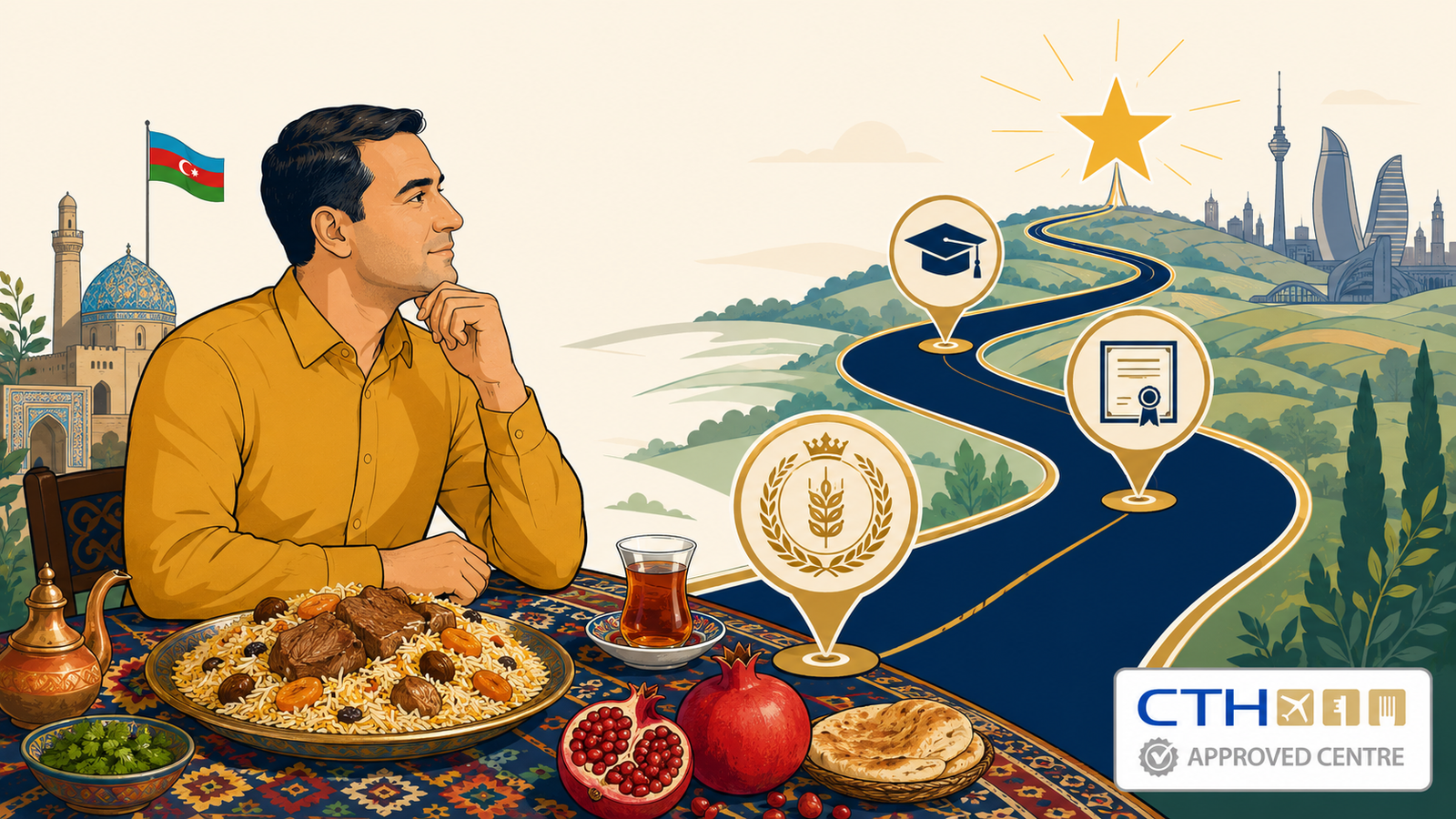
The roadmap exists. Now the question is how the entrepreneur links their own path to this map.
How does DK Agency help?
DK Agency supports entrepreneurs in the HoReCa and gastronomy sector through this transition process: operational standards, staff training, brand positioning, franchise systems, commercialization of local products and digital management.
Together with TQTA — Turan Gastro Tourism Academy — we work on training and certifying a skilled workforce for the sector.
For us, gastronomy is not just food. It is the country's cultural, economic and tourism gateway to the world.
Next step: If you want to prepare your restaurant, café, hotel or local product brand for the 2030 gastronomy tourism wave, contact DK Agency →.
Source note: The document "Azerbaijan Republic Gastronomy Tourism Strategic Development Plan (2025–2030)" and the gastronomy tourism targets set out in the document.
How DK Agency helps
If what this post describes is happening in your restaurant, café or hotel, write to us: we will look at it together and show you the first step. The first diagnostic is free.
Ask KAZAN AI about this topic
Your dish, your numbers. KAZAN AI answers from the DK knowledge base and points you to the right tool.
Open KAZAN AI