
Contents · 9 sections
- Why food cost drifts silently: five mechanisms
- Sample calculation: five products, a small increase, a large total
- System: a weekly control consisting of four parts
- E-invoice: both a tax document and ready data
- What is happening in the world: from invoice to AI
- Print: receiving and weekly control checklist
- Misconceptions
- You Don't Have to Do This Alone: AİİQA
- Sources
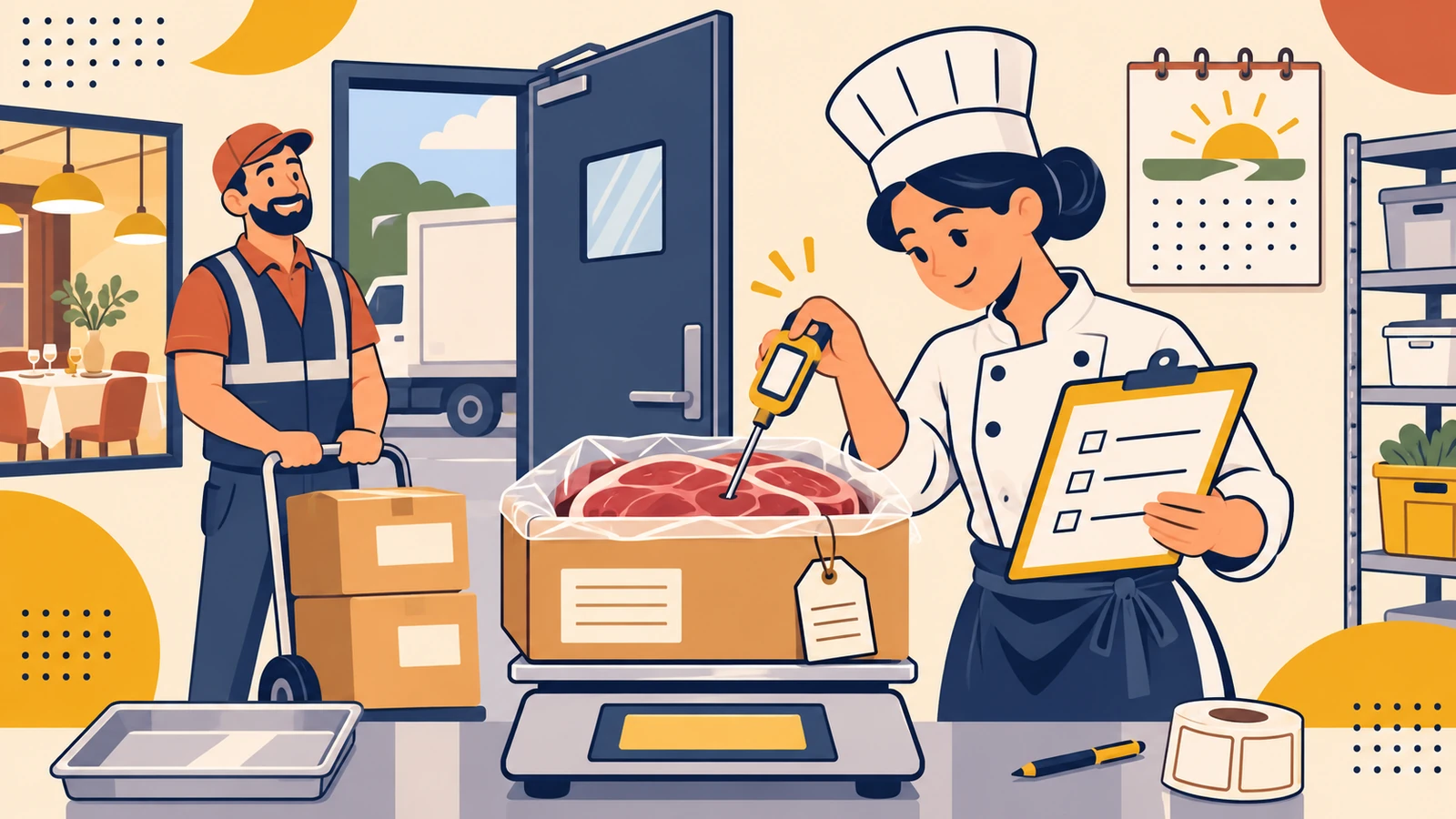
Thursday, 9:30 a.m. A 50-seat family restaurant in Sumgayit. The meat supplier's driver is at the door, in a hurry. The chef on shift carries the boxes to the fridge, signs the delivery note, puts it in the folder. At the end of the month the accountant brings the payment list, and the owner signs it without looking. The food cost report, meanwhile, says that this month food cost was 36% of sales, while last month it was 33%. The menu is the same, sales are the same, the chef is the same. "So where did the money go?"
(The scene is a generalized example.)
The answer is often not in the kitchen. The article on the site How much does 1 portion cost you? explains the recipe card, trim loss and the food cost percentage. This article looks at the link before that: at what price, at what weight and with what documents the goods enter the restaurant. No matter how precise the recipe card is, if the purchase price written into it is outdated, the card is deceiving you.
Why food cost drifts silently: five mechanisms
Most losses related to suppliers are not theft. They are mistakes, carelessness, the habit of "it always works out somehow." But the result is the same. There are five mechanisms:
1. The slow rise in price. Beef is 17.00 ₼ one month, then 17.30 ₼, then 17.60 ₼. No one calls to say "we're raising the price," the number simply changes on the delivery note. Each step is small, so it goes unnoticed. But the recipe card still says 17.00 ₼.
2. Substitution. The order was "chicken thigh, boneless, skinless," but what arrives is thigh with skin. The price is the same, but after trimming you have less meat left in your hands. Or instead of one brand of butter, another arrives, at a price 5% higher. The driver says "that one had run out," and no one writes it down.
3. Short delivery. The delivery note says 50 kg, the scale shows 48.5 kg. The box came with 11 pieces instead of 12. The invoice, however, is issued for the numbers on the delivery note.
4. Unit and packaging confusion. This time the vegetable oil came in a 4.5-liter container instead of a 5-liter one. The price of the container dropped from 16 ₼ to 15 ₼, and everyone is happy. Meanwhile the price per liter rose from 3.20 ₼ to 3.33 ₼. Units like "box," "pack," "bundle" are the easiest way to hide the price.
5. Three documents, three different numbers. One price on the order, another quantity on the delivery note, a third amount on the invoice. If no one puts the three side by side, the difference carries through to the payment.
What these mechanisms have in common: none of them is a disaster on its own. That is why no one reacts. The problem is in the sum.
Sample calculation: five products, a small increase, a large total
Let's take a restaurant with monthly food purchases of approximately 8,200 ₼. The five products that consume the most money have been selected. The "agreed price" is the price verbally or in writing discussed with the supplier, while the "invoice price" is the price actually paid over the last three weeks.
Sample calculation (all figures are illustrative, excluding VAT):
| Product | Monthly volume | Agreed price | Invoice price | Difference | Monthly loss |
|---|---|---|---|---|---|
| Beef, boneless | 280 kg | 17.00 ₼/kg | 17.60 ₼/kg | +0.60 ₼ | 168.00 ₼ |
| Chicken leg | 220 kg | 7.20 ₼/kg | 7.50 ₼/kg | +0.30 ₼ | 66.00 ₼ |
| Butter | 40 kg | 14.00 ₼/kg | 14.70 ₼/kg | +0.70 ₼ | 28.00 ₼ |
| Tomato | 350 kg | 2.40 ₼/kg | 2.60 ₼/kg | +0.20 ₼ | 70.00 ₼ |
| Vegetable oil | 150 l | 3.20 ₼/l | 3.40 ₼/l | +0.20 ₼ | 30.00 ₼ |
| Total price drift | 362.00 ₼ |
At the agreed price, these five products should have cost 8,224 ₼ per month. The price drift is approximately 4.4% of that. The difference on each line is "only 20–70 qəpik."
Now let's add a short-weight issue to this. Suppose the meat arrives on average 2% short on each delivery and no one checks on the scale: 280 kg × 2% = 5.6 kg; 5.6 kg × 17.60 ₼ = 98.56 ₼.
Monthly total: 362.00 + 98.56 = 460.56 ₼. Annual: 460.56 × 12 = 5,526.72 ₼.
If the restaurant's monthly sales are 40,000 ₼, this adds approximately 1.15 percentage points to the food cost percentage (460.56 ÷ 40,000). The owner sees "it went up from 33% to 34%" in the report and attributes this to the season. In reality, this money is neither the season nor the chef: it is at the receiving door.
Let's also look at the recipe level. A lüle kebab contains 180 g of beef, the other ingredients (onion, lavash, vegetables, spices) cost 1.10 ₼, and the selling price is 12 ₼:
- At the old price: 0.180 × 17.00 = 3.06 ₼ for meat; total 4.16 ₼; food cost 34.7%.
- At the new price: 0.180 × 17.60 = 3.17 ₼ for meat; total 4.27 ₼; food cost 35.6%.
If 17.00 ₼ remains on the recipe card, you still see 34.7%. The card calculates correctly, just with the old number.
System: a weekly control consisting of four parts
Software is not a requirement for this system. A notebook, a scale, a thermometer and an Excel file are enough. What matters is the rhythm: receiving on every delivery, reconciliation every week, and price updating.
1. Three-way reconciliation: order – delivery note/invoice – receipt
The rule is simple: three documents must show the same goods, the same quantity, the same price. If they don't match, payment stops and the difference is clarified.
- Order — what you wanted and at what price you agreed. It must be in writing: a WhatsApp message will do, but with the date and price. A verbal order makes reconciliation impossible.
- Delivery note / invoice — the supplier states what was sent and how much money is being requested.
- Receipt record — what your person weighed on the scale, counted, and returned.
The book example illustrates this well: the order is 50 kg of meat, 7.50 ₼/kg, i.e. 375 ₼. Actually 48 kg arrived, but the invoice was issued for 50 kg. The difference is 15 ₼; if it repeats every week, that makes 780 ₼ a year (the figures are examples).
In a small restaurant, the person who places the order, the one who receives it, and the one who pays are often one or two people. This is normal. But at minimum, the person placing the order and the person receiving the goods should be different people. If that's not possible, the owner should personally review the folder once a week.
2. Price tracker for key products
You don't need to track all 150 products. The bulk of the purchase amount is usually made up of 10–15 products: meat, chicken, fish, oils, dairy products, flour, main vegetables. Build the list from your own invoices: which product you paid the most money for over the last three months.
One line per product:
- precise description of the product (technical specification: "chicken thigh, boneless, skinless, chilled");
- unit: kg, liter, or piece. Not "box" and not "pack" — convert it to kg or liters;
- agreed price and date;
- actual price from each invoice;
- difference percentage;
- alert when the threshold is exceeded (example rule: an increase of more than 3% = a call to the supplier and a written explanation).
There is a ready-made free template on the site for this: Invoice price tracker (dk-qaime-qiymet-izleyicisi). You enter the price from each invoice there, and the template shows the change. The template doesn't check in your place; it simply turns checking into a 10-minute task.
3. When the purchase price changes, the recipe card is updated
The price tracker and the recipe card must be fed from the same number. In Excel, this is set up as follows: you do not write the meat price manually on the recipe sheet, you reference the "current price" cell in the price tracker. On Monday you entered the new price from the invoice, and the cards for lule kebab, minced meat, and dolma are updated automatically.
Weekly step:
- From last week's invoices, enter the prices of the main 10–15 products into the tracker.
- Mark which product has crossed the difference threshold.
- Look at the food cost percentage of the recipes that include that product.
- If the percentage is more than 2 points above the target (example threshold), decide: negotiate with the supplier, alternative offer, recipe adjustment, or price change.
If you need a quick check for a single dish, the Food Cost calculator on the site is enough: you enter the ingredients and the new purchase price, and you see the percentage.
One thing to note: you cannot change the menu price every week. The system does not tell you to change the price, it tells you when you should make a decision. Often the first step is negotiating with the supplier.
4. Receiving checklist: "check, then sign"
The moment you sign the invoice, you have accepted the goods. After that, proving a missing box or warm meat becomes difficult. That is why the golden rule of receiving is: if there is no time to check, there is no time to sign. Making the driver wait five minutes is far cheaper than accepting unchecked goods.
Divide receiving into two parts: the money side (weight, count, price) and the safety side (temperature, date, document). Both are checked at the same time, on the same sheet. The checklist is below, in a separate block for printing.
A separate note for meat and poultry: a document confirming that the product of animal origin meets veterinary standards (veterinary certificate, reference, or expert examination act, stamp on the carcass) is requested at receiving. Clarify the exact form of the specific requirement on the official website of the Food Safety Agency (AQTA) or with an accountant/lawyer. Meat without documents is not only a food safety risk, but also your problem during an inspection.
E-invoice: both a tax document and ready data
According to the official website of the State Tax Service in Azerbaijan, persons registered for VAT purposes and indicated in Article 218.1.2 of the Tax Code have been issuing electronic invoices (e-invoices) since 01.04.2017. Online, this is done in the "Electronic invoice" section of the e-taxes.gov.az portal with a strengthened electronic signature, and the document is sent to the counterparty's electronic mailbox.
For a restaurant owner, the practical meaning of this is: if your supplier is a VAT payer and sends you an e-invoice, your purchase prices are already collected in digital form in one place. Instead of re-entering the paper invoice, the accountant or manager can once a week copy the prices of key products from that list into the price tracker.
But three caveats:
- Depending on your restaurant's tax status and the supplier's status, the document you receive differs. Clarify with your accountant which of your purchases come with an e-invoice and how to view them; check the current rules on the taxes.gov.az website.
- An e-invoice shows what the supplier wrote, not what you received. The weight on the scale, the returned crate, the meat that arrived warm are not there. Only the receiving record fills this gap.
- If a discrepancy is found at receiving, request correction of the document before the e-invoice is confirmed. Agree on the correction procedure with your accountant as well.
What is happening in the world: from invoice to AI
This topic is not only our problem. In the US, restaurant back-office software is growing precisely by starting from the invoice. In August 2026, MarginEdge announced it had raised $80 million in Series D funding. According to a piece in Restaurant Technology News, the company started with "supplier invoices, one of the most data-rich areas" of restaurant operations, then expanded into inventory, recipes, payments and forecasting; it serves more than 13,000 restaurants and has processed 40 million invoices. Restaurant365, cited as the biggest competitor, launched an "intelligence engine" called R365 AI in May 2026. The same article also lists tools such as Toast's xtraCHEF (invoice automation and recipe costing) and MarketMan.
What does this mean? You photograph the invoice, the software reads the lines, transfers the price to the recipe card, and flags the increase. Such tools exist and they work.
But let's be honest: AI that takes photos does not replace receiving discipline. It reads what is written on paper. It does not know that there were 11 units in the box, that the meat arrived at 7 °C, that the brand in the order was swapped. If there is no one standing at the door with a scale and a thermometer, even the most expensive software will show you the wrong number very quickly and neatly. Discipline first, automation second. A restaurant that works by the rules with Excel for three months can easily move to any software later; a restaurant without rules will run the software half-way too.
Print: receiving and weekly control checklist
At every delivery (at the door, before signing):
- The supplier is on the approved list; the delivery time has been agreed
- I have a copy of the order (what, how much, at what price)
- Each item has been weighed on a separate scale; boxes have been opened and counted
- If the weight difference exceeds ±2%, a photo has been taken and noted on the invoice (sample threshold)
- The delivered goods match the description in the order (type, brand, skin-on/skinless, packaging size)
- The price on the invoice is the same as the agreed price; the unit has been compared per kg/liter/piece
- Chilled goods ≤ 5 °C, frozen goods ≤ −18 °C (measured inside the product with a probe thermometer)
- In frozen goods, pieces are not stuck together, and there is no excessive frost or ice
- The expiration date has been checked: the date has not passed and there is time to use up the product
- The packaging is intact, the label is present (producer, batch, date)
- For meat and poultry, a veterinary certificate has been requested and recorded in the receiving log
- Rejected goods have been removed from the invoice, and the driver has signed the correction
- The goods have been placed in the cooler or freezer within 30 minutes
- Only after this has the invoice been signed
Every week (Monday, 30 minutes):
- All invoices from the past week have been reconciled with the order and the receiving record
- The list of discrepancies has been sent to the supplier in writing
- The prices of the top 10–15 products have been entered into the price tracker
- Increases exceeding the threshold have been flagged, and an explanation has been requested from the supplier
- The food cost percentage in the recipes of those products has been checked
- Documents received as e-invoices have been matched against the paper invoice (if any)
Every month:
- Three figures for each supplier: on-time delivery, rejected goods, price change
- At least one alternative offer has been obtained for the main products
Misconceptions
"My supplier is an old friend, there's no need to check." Checking is not distrust, it is respect for the document. Most errors happen in the supplier's warehouse, during loading, or when the driver is in a hurry. A good supplier takes receiving checks in stride.
"If the price has gone up, the menu price needs to be raised." Not always. First check whether the increase is real: is it a market increase, or a price outside the agreement? Then negotiation, an alternative supplier, a recipe adjustment. The menu price is the last step.
"The one that's cheap per kilo is cheap." You pay money for gross weight, but food is prepared from net weight. Skin-on chicken thigh may be cheap per kilo, but after trimming, its net price is higher. Always compare the price per usable kilo.
"If there's an e-invoice, no receiving check is needed." An e-invoice is a tax document; it is not a scale, not a thermometer. It confirms what the supplier wrote, not what you received.
"If we buy AI software, the problem will be solved." Software reads the number on the invoice quickly. A number that isn't checked at receiving also goes into the software wrong. Automation strengthens discipline; it does not replace it.
"Calculating food cost at the end of the month is enough." At the end of the month you see only the result, not the cause. The cause is in the weekly invoices and must be reviewed weekly.
You Don't Have to Do This Alone: AİİQA
Part of controlling supplier prices is at your own door: receiving, reconciliation, price tracking. But part of it is beyond the power of a single restaurant: a small restaurant's purchasing volume is a weak position in negotiation. This is where collective purchasing is directly relevant.
The Azerbaijan Public Catering and Gastronomy Association (AİİQA) emerged from the Public Catering and Gastronomy Forum held on 14 August 2026 at Four Seasons Hotel Baku; 231 representatives of the sector attended the forum. There, a trilateral memorandum on digitalization and payment infrastructure (Clopos, the Association and Bir Ekosistem) was signed.
On 23 September 2026, the initiative group formed a 9-member Board of Directors: chairman Mübariz Quliyev (founder of Sumqayıt's "Turan Restoranlar Şəbəkəsi"); deputy chairmen Doğan Tomris (Turan Gastro Tourism Education Center), Rəşid Hüseynov ("Yaban" restaurants and pubs), Anar Rəsulov (Clopos, operations director); secretary general Seymur Aslanlı. For transparency: the author of this article, Doğan Tomris, is a deputy chairman of the Board of Directors.
According to the association's bulletin, more than 25,000 public catering establishments operate in Azerbaijan and more than 290,000 people work in the sector.
The announced next steps: finalizing the charter and applying to the Ministry of Justice for state registration; forming permanent commissions. Membership registration will officially begin after state registration.
Planned directions (these are currently a plan, not an existing service):
- Vendor Hub — collective purchasing power in negotiations with suppliers;
- AİİQA Academy — training;
- CV Bank — staffing;
- Star Classification — quality rating;
- representation of the sector before state bodies (Tax, AQTA, KOBİA, ASK).
In terms of the topic of this article, the closest direction is Vendor Hub. But let us note one thing: collective purchasing does not replace receiving discipline either. Even the best-negotiated price, if it is not checked at the door, still slips on the invoice.
At the time this article was prepared (November 2026), the state registration process was ongoing and the association's official website did not yet exist. When membership begins, the information will be announced on the association's official channels.
Sources
- State Tax Service, "Electronic invoice" page (persons registered for VAT, Article 218.1.2 of the Tax Code, 01.04.2017, online/offline preparation procedure): https://www.taxes.gov.az/az/page/elektron-qaime-faktura
- Internet Tax Administration portal: https://www.e-taxes.gov.az
- Restaurant Technology News, "MarginEdge Raises $80 Million as Competition for the AI-Powered Restaurant Back Office Intensifies", 12.08.2026: https://restauranttechnologynews.com/2026/08/marginedge-raises-80-million-as-competition-for-the-ai-powered-restaurant-back-office-intensifies/
- Restaurant365, "Restaurant365 Introduces R365 AI", 12.05.2026: https://www.restaurant365.com/in-the-news/restaurant365-introduces-r365-ai-the-only-intelligence-engine-built-on-the-full-restaurant-pl/
- Food Safety Agency of the Republic of Azerbaijan (AQTA), official website (veterinary documents and control): https://afsa.gov.az
- Doğan Tomris, Restaurant Management book (TQTA), Lesson 4.2 "Supplier and Purchasing" and Lesson 4.3 "Goods Receipt and Cold Chain" (in preparation for publication; temperature limits are the TQTA standard).
- Azerbaijan Public Catering and Gastronomy Association (AİİQA), press bulletin (23.09.2026) and strategy note (online version not published).
- DK Agency free tools: Excel templates — Invoice price tracker, Food Cost calculator
How DK Agency helps
If what this post describes is happening in your restaurant, café or hotel, write to us: we will look at it together and show you the first step. The first diagnostic is free.
Ask KAZAN AI about this topic
Your dish, your numbers. KAZAN AI answers from the DK knowledge base and points you to the right tool.
Open KAZAN AI